




I’ve recently reported on two major contracts that SeAH Wind has lost in 2026. The company now faces a difficult future, as it tries to focus on its only remaining deal.
Perfect storm
First of all, a recap on recent developments. On 12 February, I reported on how SeAH Wind had lost its inaugural contract to supply monopiles (bases) for the Hornsea 3 offshore wind farm in the North Sea. You can read about this here. This was followed, on 27 April, with news that SeAH had lost its next job. This was a deal to supply monopiles to the Vanguard West portion of the Norfolk Vanguard project. The details of that can be found here.
Going forward
SeAH still holds a contract to supply monopiles to the Vanguard East portion of its deal with RWE. As I reported back in April, the Vanguard East wind farm isn’t scheduled for completion until 2030. Over the coming months, SeAH will attempt to ramp-up production on the Vanguard East monopiles, closely monitored by RWE to ensure that quality standards are being met. If they aren’t, RWE has the option to go back to the market for another supplier. SeAH doesn’t have any further contracts in the pipeline.
And SeAH Wind is burning through cash
SeAH Wind has been spending money on its Teesworks project for more than four years. Construction commenced on 7 July 2022. But, in almost four years since then, SeAH Wind has made no sales, and generated no cash. If all goes well, RWE may accept some completed monopiles towards the end of 2026. This should start generating income for the company. But, in the meantime, the spending continues.
Snapshot
I’ve taken a snapshot of the company’s finances, as of June 2026. As part of this snapshot, I’ve analysed a scenario in which the company runs out of cash and ceases trading. It’s important to note that I am not predicting the demise of SeAH Wind. However, it’s a worthwhile exercise to game a worst-case scenario.
Expenditure by SeAH Wind
In June 2022, a month prior to the start of construction, the budget for the factory was estimated at £300mn. As is always the case, builder’s estimates are rarely accurate. Just over two years later, the cost had tripled to a reported £900mn. The company itself has never stated the cost of construction.
Costs of production
SeAH Wind has had to purchase steel to make monopiles, along with welding materials and gases. Then there are labour costs, including an extensive training programme.
Rent and rates
In February 2026, the South Tees Development Corporation (STDC) noted that the Valuation Office Agency was undertaking work to determine the rateable value of the factory. This report was expected ‘in the next month or two’. However, the work still hasn’t been completed, and there is no way of knowing SeAH Wind’s business rates liability. The company website still states that the factory is only 99% complete, despite claiming, in July 2025, that it had started production of monopiles. As revealed by Private Eye magazine in its ‘Stripped Tees’ special report, SeAH Wind pays an annual lease of £4.3mn for the factory site.
How much has the company spent?
In the absence of any information from SeAH Wind itself, the Companies House record is the only reliable source of information. The latest full set of accounts, for the year ending 31 December 2024, was published on 14 August 2025.
Borrowings
The annual accounts show loans and borrowings of £637mn at December 2024. I’ve calculated that these loans will have accrued an additional 5% in interest since then. This would bring current borrowings to £669mn.
Equity raising?
So, given the above borrowings, and for a project now costing well in excess of £1bn, where is the rest of SeAH’s money coming from? This is being achieved by raising share capital, in the form of ‘rights issues’ to existing shareholders. It has to be assumed that these shares are held by the South Korean holding company, SeAH Group. As at 31 December 2024, an excerpt from the company accounts shows ‘total equity’ of £209mn. The ‘share capital’ shows the nominal value of shares issued. The share premium reserve is the amount that was paid for these shares in addition to the nominal value. The negative ‘retained earnings’ are a calculation of losses to date.
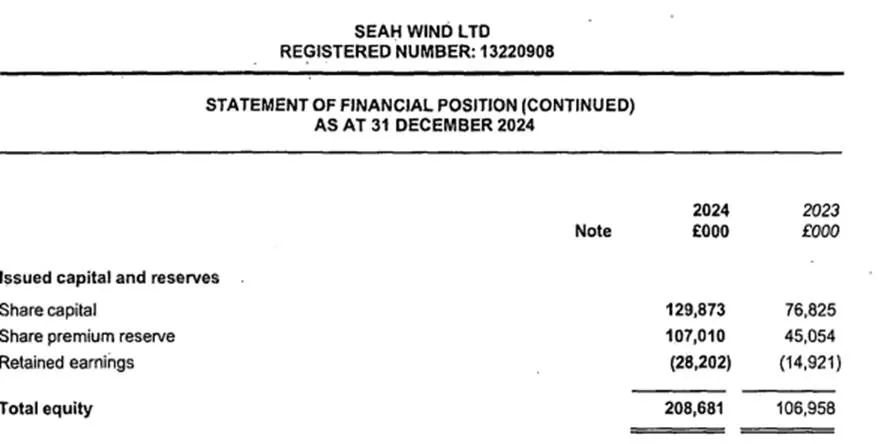
Regular capital raising
Since the December 2024 accounts were published, the company has raised capital on seven further occasions, as can be seen in this excerpt:

Note, however, that each ‘Statement of capital’ records the ‘par’ value of £5 for these shares. In fact, each share was sold at more than £11. I’ve calculated the actual capital raised since December 2024 below:

So what does this tell us?
This regular capital raising may indicate that the company is unwilling, or unable, to borrow further funds. The amount of capital raised has increased from £237mn in December to 2024 to £468mn today. SeAH wind has had to raise capital four times already in 2026, in excess of £94mn
How much has the SeAH Wind project cost to date?
If we take the total amount of capital raised, £468mn, and add it to total borrowings, £669mn, then SeAH Wind has spent £1,137mn on the project to date.
Worst case scenario
So, what would happen if SeAH Wind Ltd was to go into administration given the current financial situation?
Borrowings
Most of the company’s borrowing is guaranteed by the UK and South Korean governments. SeAH Wind has loan facilities of £590mn from Standard Chartered and HSBC banks. These loans are from UK Export Finance (UKEF) and K-Sure respectively.
An uneven split
However, the guarantee isn’t an even 50/50 split. When the first £367mn loan was arranged in November 2023, £257mn of this was guaranteed by UKEF. A further loan of £225mn, was made in October 2024. UKEF was responsible for £157mn of this guarantee.
Guess who pays?
In the event that SeAH was unable to repay any of these loans, the banks would be able to recover £414mn from UK taxpayers and £176mn from the South Korean exchequer.
Other loans
So, leaving aside the £590mn in guaranteed loans, there are another £79mn in borrowings. The banks hold a ‘charge’ on plant and machinery at the SeAH Factory, so they’d be able to recover some, or maybe all, of their borrowings by selling this plant and machinery.
Equity
As noted above, the 31 December 2024 accounts showed negative retained earnings (ie losses) of £28mn to date. There may have been further losses recorded in 2025, but we won’t know this until the 2025 accounts are published in August 2026. But, in the event of a worst-case scenario administration, the shareholders, ie SeAH Steel Holdings in Seoul, South Korea, would lose their remaining equity of £440mn.
Hold your nerve
So, will the SeAH Steel Holdings board members in Seoul wait patiently until the cash starts coming in at the end of 2026? They’ll probably have to raise another £100mn to keep SeAH Wind in Middlesbrough ticking over until then.



