
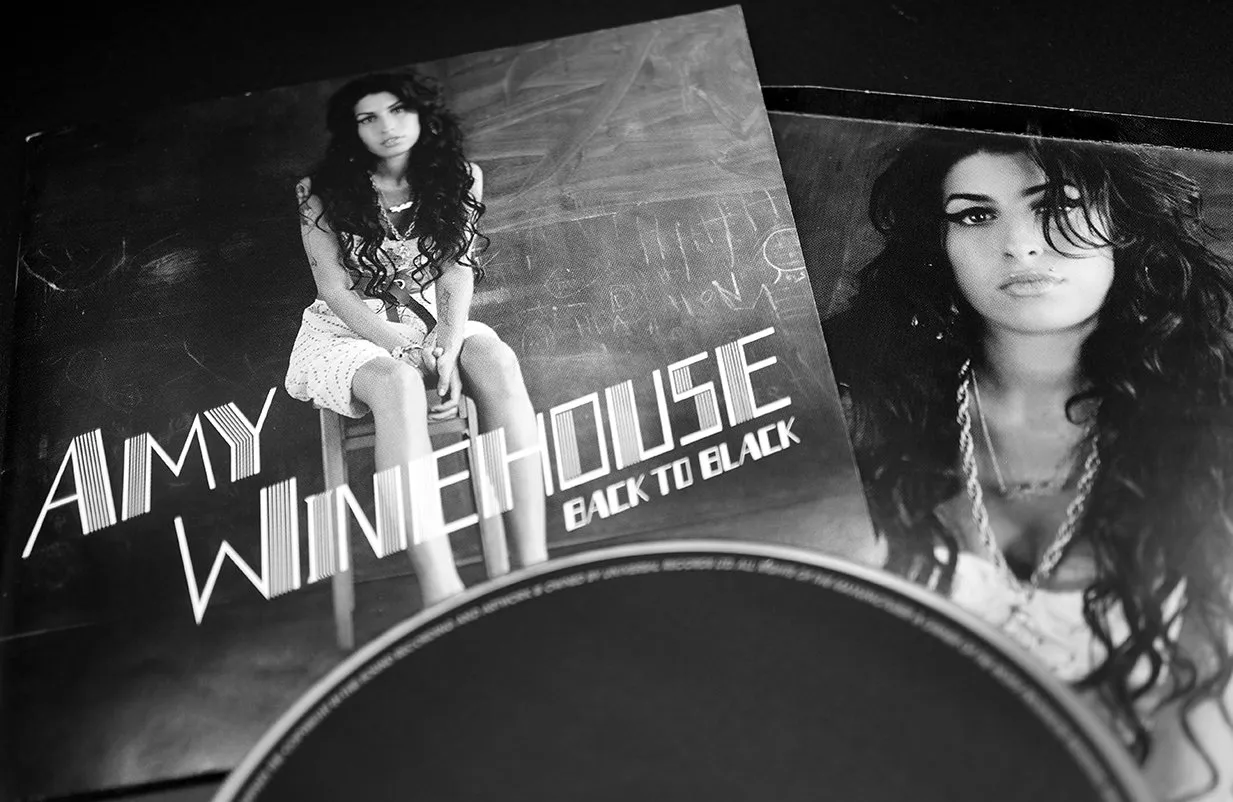
The late Amy Winehouse, one of the most iconic singer-songwriters and five-time Grammy award winner, is often regarded as the woman responsible for changing the landscape for female music. Unfortunately, Amy is also a woman who has always remained under the cruel eye of the media, even after her death in 2011 at the age of 27. It would be a disservice to Amy Winehouse not to address this issue.
So many of our opinions about Amy have been made up by what we’ve seen after her death, and Winehouse has suffered even after her untimely death from vicious disrespect. For example, Neil Patrick Harris’ vile Amy Winehouse corpse platter for his Halloween party just three months after Amy’s death, which Patrick Harris recently apologised for in 2022. Another example is an auction that took place in 2021 by Julien’s Auctions, featuring everything from Amy’s dresses to her bras and used lipsticks. This auction aimed to raise awareness for young adults facing addiction, but was controversial as some fans of Amy regarded this as ‘raiding a dead woman’s closet’.
This is why I was immediately on edge when I went to watch Sam Taylor-Johnson’s Back to Black last week, as even in her death, the public and the media have not been gracious towards Amy Winehouse.
I must admit, Back to Black left me with a sour taste in my mouth. Though Marisa Abela’s performance as Amy was compelling, I couldn’t ignore feeling confused. One of my biggest questions was – why didn’t they just use Amy’s vocals? Whilst I agree Abela’s voice is mesmerising, and her voice definitely bears great likeness to Amy’s, I couldn’t get past the fact it wasn’t Amy singing. Other fans also felt this way, and Back To Black music producer Giles Martin (son of the Beatles producer George Martin) commented on this, found in a Daily Mail article. He said: “I think people always go, ‘It’s not Amy Winehouse singing?’ I go, ‘Well, it isn’t Amy Winehouse singing!”. It’s interesting that Taylor-Johnson revealed in the same article that she did think of using Amy’s vocals at first, but after Abela decided to undergo singing and guitar lessons they decided to include this in the film. Although Abela is an extremely talented performer, I do still think that the film would have done a better service to Amy Winehouse’s legacy if they’d been able to use her voice.
Amy’s relationship with her ex-husband
The film seemed to arguably cut Amy’s legacy down to her relationship with her ex-husband, Blake Fielder-Civil. Winehouse and Fielder-Civil had a tumultuous relationship, married for two years from 2007-2009. Many fans of Amy speculate that Fielder-Civil was one of the biggest reasons for her downfall, as he admitted to being the one who introduced Winehouse to heroin.
Back to Black alludes that after the pair broke up for the first time in 2008, Fielder-Civil made the calculated choice to reignite their relationship so he could use Amy’s money to fund his drug addiction. Found in a Radio Times article, Fielder-Civil had recounted that the pair “used heroin together as addicts for, like, four months.”
This too is definitely shown in Back to Black, but what isn’t shown is Blake filing a lawsuit of £1 million against Winehouse’s parents in 2019. When Amy Winehouse unexpectedly passed in 2011 at the age of 27, she had not written a will so her estate went to her parents, Mitch and Janis Winehouse. Fielder-Civil felt he deserved this share as he was married to Amy when she was at the height of her career, but her parents disagreed, which could be down to the fact Amy gave Blake £250,000 during their divorce in 2009.
Amy’s father
Many fans accused Amy’s father Mitch of riding on her coattails during the success of her career, as people have suggested he was exploitative during Amy’s stardom and even enabled her addiction by pulling her out of rehab a number of times. As many fans know, Amy had reflected on the latter issue in her hit song Rehab with the lyrics “but if my Daddy thinks I’m fine”. This also featured in the film, where Amy’s friend Nick Cave stages an intervention with Amy and her father and begs her to go into rehab. Amy refuses and Mitch does not interfere.
Towards the end of Back to Black, Mitch even takes Amy to rehab before the end of the film. However, it is not depicted that he removed her from rehab multiple times. What is also left out of the film (for good reason) is that Mitch Winehouse launched his own album in 2010. When interviewed in 2011 before Amy’s death, he reminded people that “it was my name first. I was here before Amy. But I know that I only got the chance to make the album because I was Amy’s dad”.
However, in Amy (2015), a documentary-film about Amy Winehouse, filmmaker Asif Kapadia heavily alludes to a rocky relationship between Amy and her father. Mitch was openly unhappy about his portrayal in the film as expressed in an interview, so it is no question as to why Mitch Winehouse chose to be present on set for a majority of Back to Black.
Tragedy
I also felt quite often that Back to Black was stuck on the tragedy of Amy Winehouse’s life. Winehouse had candidly admitted in numerous interviews that she had an eating disorder, battled manic depression and engaged in self-injury. She also publicly acknowledged her drug and alcohol abuse. This is no doubt a part of her life, but I felt as though Back to Black never seemed to capture Amy’s attempt to better herself.
Winehouse enrolled in rehab a few times, but we only see this once during Back to Black. By only showing Amy ‘get better’ once, I feel as though this was a calculated effort to fit the narrative that Amy was never really going to recover.
One thing my boyfriend and I both agreed was done well by Back to Black was the end of the film, because there was no scene that vividly demonstrated Amy’s death by alcohol poisoning in 2011. This came as a relief, as Amy should be remembered for her life, her legacy, her music – not for her death.
The film’s ending
The ending of the film implied that Amy drank herself to death after a news reporter told her about Blake Fielder-Civil’s new girlfriend and child (it is heavily referenced throughout the film that Amy wanted to be a mother). In reality, Amy had been in a two-year relationship with Reg Traviss. Back to Black fades out with a black screen telling the audience Amy died on 23 July 2011, then finishes with a performance of Abela singing Rehab. Another critique I had of this ending was I would have liked to see a recording of Amy Winehouse singing: this was the last missed opportunity to feature Amy’s real voice. I felt that Back to Black really missed the mark multiple times when it came to cementing the legacy of Amy Winehouse, and I would even argue that some of this was just lazy.
When leaving the cinema, my boyfriend asked my thoughts on the film. I won’t lie – it was a moving film. Abela’s performance of Amy had me in tears multiple times during the screening. Amy Winehouse was so unique in every aspect of her life so it was definitely hard for Abela to encapsulate her properly, but I felt Abela did a great job. However, I did feel as though the film shouldn’t have even been made.
Part of me felt Back to Black was a response to Amy, as Mitch Winehouse had voiced his disapproval on this film. I felt both films were produced too soon after her death, as Winehouse only died 13 years ago. Also, unlike in Dexter Fletcher’s film Rocketman, which is loosely based on Elton John’s life, Winehouse was unable to have any influence in her own biopic. Maybe something similar to Gurinder Chadha’s film Blinded By The Light (influenced by Bruce Springsteen) would have been more appropriate? A great storyline could have been a coming-of-age film that follows a character that is heavily influenced by Amy Winehouse’s music.
As we walked out of the cinema, I couldn’t help myself thinking, why can’t we just let Amy rest and remember her for her music? Why are we sensationalising her life for entertainment? In my humble opinion, a documentary that reflected on Amy’s early life, showing what got her into singing, showing her success, would have been much more appropriate.