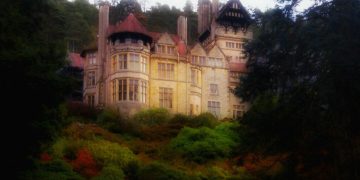
Stores have been displaying Halloween goods for a while now; costumes, pumpkins, sweets for giving to children who come visiting on the evening of Halloween, spooky decorations and even party food. This merchandise may now emphasise the celebration of this event, but the occasion itself has a long history.
The history of Halloween
Halloween harks back to the ancient Celtic festival of Samhain, celebrated mainly in Scotland, Wales and Ireland. Samhain occurred at the end of harvest and the beginning of winter. At this time, the gap between the land of the living and the land of the dead was at its weakest. It was believed that spirits could then more easily return to Earth. Masks, costumes or animal skins were donned so that the avenging ghosts of the dead would be unable to recognise their potential victims. Bonfires were lit and Jack O’ Lanterns were carried to ward off the evil spirits.
Christianity adopted the festival of Samhain into All Hallows Eve. The evening prior to this Eve, early Christians remembered the dead, including the saints and martyrs, the hallowed or holy ones.
These earlier celebrations included the making of ‘soul cakes’, a kind of spicy shortbread biscuit with the mark of a cross on the top. ‘Soulers’, frequently children, went from door to door singing and saying prayers and were given a ‘soul cake’ at each dwelling. The ‘soulers’ were frequently disguised and carrying lanterns to signify the souls which were trapped in purgatory.
Immigrants to America from Ireland and Scotland took their customs with them and the customs were transformed into a macabre celebration. Turnips had been carved out with a candle inside to provide a lantern, but pumpkins in America had much softer flesh and easier to carve, so pumpkins for lanterns became the norm. ‘Soul cakes’ became sweets to give out to the children. The prayers and singing disappeared. The costumes remained and became more elaborate. Houses were decorated and parties often held. Games like apple bobbing continued as did to some extent the peeling of an apple and throwing the peel over one’s shoulder to ascertain the initial of one’s potential spouse.
Witches
One costume is especially popular; the witch. Witchcraft goes back a long way. The Witch of Endor is quoted in The Bible. In Ancient Greece, Rome, Egypt and Mesopotamia magic was an integral part of their religion. Greek legend had its Medea and Circe. In the present witches and wizards have a positive image thanks to Harry Potter, The Wizard of Oz and such like. However, in the past, witches and witchcraft and the power of evil spirits were greatly feared as was the power of evil spirits.
In 1486, the German Catholic clergyman, Heinrich Kramer wrote the Malleus Maleficarum, broadly translated as, The Hammer of the Witches. Kramer defined witchcraft as heresy, the greatest of sins. He advocated the need for confession by any means and the subsequent death of the witch so that the ‘evils of witchcraft’ and its dangers could be eliminated. Pope Pius V111 brought Kramer’s work to light in a Papal Bull. In Europe during the 15th -17th Centuries, there were about 60,000 executions for witchcraft, the highest figure occurring in Germany. 80% of these victims were women. Hysteria abounded with often the unfortunates being accused of the crime of heresy and witchcraft by neighbours in their village.
As well as the influence of the Malleus Maleficarum, King James 1st penned the Daemonologie. This work, separated into three books emphasised witchcraft as being ‘treason against God.’ This work saw witches as being slaves to the devil and encouraged the practice of witch-hunting, leading to a dark history surrounding witches. In East Anglia during the English Civil War Matthew Hopkins was greatly influenced by this, so much so that he defined himself as being ‘The Witchfinder General.’ Sleep deprivation was one of his methods of torture to extract confessions from his victims. Another method to define a witch was to tie them to a chair and throw them into the river. If they floated, they were a witch as they water would not accept them for baptism. If they were lucky enough to sink and not drown, they were cleared of the sin of heresy and could survive. Even having the ‘mark of the devil’ like a mole or birthmark could lead to suspicion and being accused of being a witch. Those accused and found ‘guilty’ of witchcraft were hanged but not burned at the stake as they were elsewhere. Because of his actions, about 300 ‘witches’ were tried and executed. In 1647, Hopkins published The Discovery of Witches, citing Daemonlogie as being the guidebook to his ability to identify witches.
Easington Village
Easington Village has its own ‘witch legend.’ Seaton Holme was the residence of the archdeacons of Durham Cathedral. Not far from Seaton Home and the Church there lived an old woman. She was not well liked in the village as she was very bad tempered and ill-mannered. Suspicion grew around her as she never went to church.
Hunting was a great sport at the time, but the hunters appeared to have no luck. They would be following their prey with their dogs when a hare would appear as if from nowhere, darting rapidly here and there and cunningly leading the dogs away from the scent of the prey. Suspicion mounted that this hare had links to the supernatural. The Master of the Hunt sought out a special black bloodhound that was said to have suckled on human milk and had the plan to set the bloodhound on the trail of this elusive hare. So, he did. The hare twisted and turned with the bloodhound in chase. It could not escape the bloodhound as it had the other dogs. The exhausted hare raced through the village heading for the cottage of the old woman who many suspected was a witch. The cottage door had a gap in the bottom so that chickens could wander in and out. Just as the hare was running towards this gap, the bloodhound caught it in its leg before the hare escaped inside.
The hunters hurried towards the cottage and rushed inside. There was no hare to be seen. Instead, the old woman, exhausted and sweating was slumped in a chair beside the fire, her leg raised up with blood streaming down on to the floor. It was agreed the old woman must be a witch and that she had shape shifted into a cunning hare to lead them away from their prey. The old woman confessed that they were correct but as blood had been drawn the hunters agreed that her powers had been depleted, so she was left alone. The hunt was never interfered with again.
Halloween has a history. Next door to me the house has been decorated outside in true witchy, spooky style. I am looking forward to the two young neighbours with their dad, as well as other youngsters eagerly knocking on the door for sweets I know they will receive from other neighbours too. I’ll not spoil their fun by giving them a history lesson!