


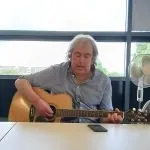

When did you first get into music and who were your first influences?
I’ve always loved music, I remember enjoying TV themes as a young lad, then I saw Sonny Boy Williamson II on our old black and white television and things started to change. A schoolmate’s older sister lent me an EP by Sonny Terry and Brownie McGhee. After that the rest just followed.
I wanted to sing like Muddy Waters, play harmonica like Little Walter Jacobs and be as tall as Howlin Wolf…alas it never happened. But Ray Charles led me to Soul and some Gospel music. Otis Redding, Wilson Pickett, James Brown and The Staple Singers.
Who were your first bands and what type of music did you perform?
I think my first band was The Graveyard Shift when I was at school. We played 1960s R&B music, a lot of Chuck Berry as well.
After I left school I played guitar, harmonica and sometimes piano in a few local bands. With some mates from Art College we formed (the obligatory) Art School band, The Steel Mill Blues Band. After that I joined a short-lived club band called The Mel James Set, that didn’t last long…we weren’t very good.
Next came another working men’s club band called Dice. As we tired of doing the clubs we decided to take some time out and work on one or two of our own numbers. So Dice eventually morphed into The East Side Torpedoes.
Originally a five piece, Ian Rutland guitar and vocals, Derek Nicholas bass and vocals, Steve Colley keyboard and vocals Trevor Wearmouth (shortly replaced by) Phil Whitton on drums and I was second guitar and did vocals.
The horn section came not long afterwards, Al Wilson alto sax, Ian Robinson trumpet followed by Terry O’ Hern on trombone.
Any interesting stories from the early days?
Oh yes, but not a lot I’m prepared to talk about…well ok, maybe one.
The East Side Torpedoes had done a gig at Dingwalls in Hull. When we arrived back to our boarding house (not far from the venue) we were delighted to find that the landlady and her husband had kept the bar open. The band drank into the early hours but eventually gave up and staggered off to bed.
“Beezer” Bob Kirkwood the road manager, did not and continued boozing. When he’d had enough, he set off to literally crawl to his room on the top floor. He gave up when he reached the second landing, curled into the foetal position and slept it off.
In the morning after a huge full English breakfast swimming in lard, he got us on the bus and on to our next gig.
“Beezer” Bob, a wonderful fella and a great roadie…with the constitution of an ox!
How did The Smokin Spitfires come about?
One night Terry O’Hern, Steve Coley and I were drinking Guinness in The Travellers Rest, Cockerton, Darlington. As we weren’t playing in any bands at the time, we thought it might be an opportunity to put together a band playing original material. Just to see if we could.
We recruited players who knew of The East Side Torpedoes but weren’t familiar with the songs. So some of the older tunes would be played their way. Making some difference, we hoped between The Torpedoes and The Spitfires.
How did the link with The Bubble Foundation come about?
Gill Wheeldon who is the Fund-Raising Manager for The Bubble Foundation, used to come to the Sunday lunchtime sessions The East Side Torpedoes played in The Newcastle Playhouse Theatre foyer. When she started working for The Bubble she would ask The Torpedoes (and later) The Spitfires to do the occasional fund raiser.
It was her idea to start the regular Sunday afternoon gigs at The Cluny. The first Sunday of every month.
We’ve augmented the band to a ten piece playing a full first set of originals then a second of Soul and Rhythm and Blues covers…now we’ve become The Mighty Smokin Spitfires.
How much have The Smokin Spitfires raised for The Bubble?
Since September 2013 the band has raised £24,000 for The Bubble Foundation. (And possibly a good £7000 more if it hadn’t been for Covid and my throat ulcer).
What is The Bubble Foundation?
The Bubble Foundation supports the work of The Children’s Bone Marrow Transplant Unit at The Great Northern Childrens Hospital, where they look after children born without an immune system. Without treatment these bairns would all die.
The Foundation funds toys, educational equipment and supports parents and siblings. It helps to buy special medical equipment and most importantly medical research, finding better, less painful treatments for these precious children.
Gill, at the last count, has raised five million pounds for The Bubble, which is a considerable amount…but is unfortunately just a drop in a huge ocean.
Now that I’ve kinda retired I volunteer two mornings a week at a local food bank. And it makes me angry that there are so many charities in this country asking for help when there are many companies giving out huge bonuses to people who certainly don’t deserve or need them. And we have a government spending millions of taxpayers money trying to fly a plane to Rwanda.
There should be no need for food banks and charities like The Bubble Foundation but unfortunately it appears there is.
The Mighty Smokin Spitfires play the first Sunday in every month at The Cluny, Ouseburn, Newcastle upon Tyne. Start 12.45 p.m.
They are:
Neil Hunter vocals, Gary Cain drums, Bob Garrington guitar, Ian Rigby bass and vocals, Mike Hepple keyboard and vocals, Lloyd Howell percussion, Terry O’Hern trombone, Dave Blakey trumpet, Alan Thompson tenor sax and Steve McGarvie alto sax and vocals.
The smoking Spitfires Facebook page is here.
More Information about the Bubble Foundation can be found here.
And you can donate to the Bubble Foundation here.



