


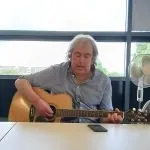

Lesley Hagon is chair of the Newcastle Reform Synagogue. Here she talks about being Jewish in the North East in 2026, the rise of antisemitism and her hopes for the future.
What is your backstory?
50 year career in education which includes working as an Equal Opportunity Advisory teacher, five years as a Headteacher of an Orthodox Jewish Primary school in East London, being an OFSTED inspector, working with Higher Education and FE colleges, teaching ESOL to refugees and training teachers working in England and abroad.
I joined Newcastle Reform Synagogue (NRS) in 2016 and became Chair of the Council in February of this year. I live in Durham.
What would you say is the level of anti-semitism in and around Newcastle at present?
That I cannot answer. You would need to ask the police for data on previous years.
But there is a change in atmosphere and attitude.
Whilst we have not had any incidents ourselves, many of our members have links across the country and connections with all the establishments and personnel that have been attacked. This has increased the feeling of vulnerability.
We have become more vigilant about security and liaise closely with police and security organisations.
On a personal basis I am more aware of when I wear my Star of David and when I disclose my Jewish identity to new acquaintances. I am fortunate to have a close and supportive circle of non-Jewish friends but I know that others in the community are also watchful as to how they disclose their identity on a day-to-day basis.
I am more sensitive to the many embedded social tropes that reflect embedded antisemitic attitudes demonstrated in comments that are said without the person saying them being aware that they display discriminatory attitudes eg on buying a car “just let your community know you need one – they will have lots of money and cars to spare”. “Why do Jews always say they are Jewish first before stating their nationality ?”
NRS works hard to have a profile in as much civic and social activity as possible eg inter-faith activities and this year we held our first Iftar to demonstrate our commitment to social diversity and inclusivity.
This is in response to the increase in antisemitic activities in other cities and the rise in far right political groups in the local area.
It is also important to broaden local people’s awareness of Judaism which locally is focused on the Charedi community of Gateshead. We are not an orthodox community and as a member of the Progressive Judaism movement we offer an opportunity for everyone to engage with us. This is why our school visits programme is of such importance. We have 2-3 schools visit us each week during term time and both pupils and teachers learn about practice and faith but also about our ‘normality’ in society.
How does that compare to times past?
As is common around the country Jewish communities wax and wane. This has resulted in the closure of synagogues or the reduction in services for the community due to the lack of availability of personnel to lead services. We have a visiting Rabbi as opposed to a permanent one and have had to become more self-sufficient in leading services. We are fortunate in an increase in our membership numbers due to families moving into the area who want to be in proximity to a community hub that will enable them to nurture the Jewish identity of their children.
But overall, I would say that in times past the Jewish community could be confident in going about its business with little interference. After all there is a long history of Jewish businesses contributing to the development of such areas as Team Valley as an area of industrial growth and Sunderland and Darlington which now have a dwindling Jewish population
Now Jews are aware that they are criticised and verbally attacked in the press on a regular basis.
The automatic association between Israel and the Jewish community and the assumptions on beliefs and attitudes that follow has made people wary of openly discussing what is happening in the Middle East
What do you think is driving it?
NRS is very aware of the increase in right-wing political parties and the increased encouragement of covert right-wing activity that is seen as being socially acceptable.
The conflict in the Middle East has resulted in polarised views and the assumption of the unquestioned connection between Judaism as a faith and the politics of the Israel government as expressed in newspaper, TV reporting and social media.
The focus on immigration as a negativity and the protection of ‘borders’ as opposed to the demonstration of compassion, the lack of responsibility for the creation of situations of conflict that result in people seeking safety in other countries, the ignorance of the nuances of social groups, and the wilful lack of understanding of the benefits of diverse social groupings all result in ignorance and lack of emotional intelligence being demonstrated by those in leadership positions.
The encouragement of polarised views in social media platform encourages people to feel confident in expressing misinformed and uninformed opinion
What would you say to people who feel that antisemitism is acceptable in the North East in 2026?
There is a history of social inclusivity in the North East that has resulted in its identity as a powerhouse of social action and compassion.
No form of any discriminatory behaviour is acceptable. Antisemitism within the broader scope of racism is unacceptable on any level and only serves to reduce communities and doesn’t allow them to grow and flourish.
As a community with roots in the refugee experience, we are committed through our Social Action Group to offer support to various local agencies that support refugees and asylum seekers. We recently held a fundraiser for SAG and as a result can now share £600 across The Hub, The Comfrey Project and the Peoples Kitchen. Several members offer their time to the agencies
Why is it important to remember the Holocaust every January?
Because it reminds us all of how far right-wing politics can go – that the verbalisation of fascist opinion is increasing and dangerous.
That the discrimination of people identified as ‘other’ and their dehumanisation is ever present within society and should be fought against.
How do you feel about the work of Standing Together in Israel and here?
NRS has promoted the work of Standing Together as a positive approach to conflict resolution. We hosted a session speaking with a Palestinian member and several from community have joined and attended rallies. We report regularly in our newsletter about events.
How would you like to see community relations progressing in the North East?
We have reached out to the Muslim community and members attended our Iftar. We would like to see a strengthening of that relationship.
We would like to see that as a progressive synagogue we are viewed as representing a significant number of the Jewish community and be seen as a valid contributor to social and civic forums alongside the Orthodox community
Anything else you would like to add?
I appreciate you giving us a voice



