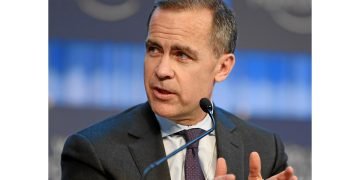
“These benefits of Brexit seem to be like a toddler’s imaginary friend. Ministers keep talking about them, but only they can see them”
Stella Creasy
Brexit anniversary
On the third anniversary of our final departure from the European Union the effects of that departure are slowly becoming apparent. However, the government persists in claiming that any problems with the economy are the result of the Covid epidemic and the war in Ukraine.
Coincidentally, the International Monetary Fund (IMF) issued its new forecasts for the global economy, which predict an improving outlook for all developed economies, except for the UK. The 2023 economic outlook for the UK is downgraded from plus 0.3% to minus 0.6%. Are Covid and the war in Ukraine affecting us more than other comparable economies, or is there something else impacting the UK?
The UK Office for Budget Responsibility’s Brexit analysis, last updated in May 2022, calculates:
“The new trading relationship between the UK and EU, as set out in the ‘Trade and Cooperation Agreement’ (TCA) that came into effect on 1 January 2021, will reduce long-run productivity by 4% relative to remaining in the EU”
and
“Both exports and imports will be around 15% lower in the long run than if the UK had remained in the EU.”
In May 2022 we were clearly being warned of the effect of Brexit on our economy. Since publication of this assessment, Liz Truss tried to implement a true ‘Brexit Budget’, as lauded by free market Brexiters, with disastrous economic consequences for her political ambitions and the finances of almost everyone in the country.
A toddler’s imaginary friend
Naturally, the involvement of Brexit in the IMF’s dismal projections was raised in parliamentary debate when Stella Creasy compared governments claims of great Brexit benefits to “a toddler’s imaginary friend. Ministers keep talking about them, but only they can see them”. She asked Treasury minister James Cartlidge:
“The prime minister’s spokesman today told us that we are now seeing significant benefits from Brexit, so will the minister set the record straight?”
Cartlidge referenced reduced protections against insurance company failure and revised alcohol duties. He noted that the most important by far was when “this country was able to move fast with an amazing vaccine programme because of its independence, which reduced deaths and freed up our economy, and allowed us to reopen and get growing again”. Interestingly his most important by far Brexit benefit is untrue. The vaccine rollout was approved and procured while we were still under EU rules, Brexit had no bearing on our early vaccine rollout. In fact, leaving the EU may very well have delayed our vaccine rollout after the AstraZeneca jab became contraindicated for under-40s. A review of the vaccine rollout in the Byline Times last year concludes that:
“These facts have not only been concealed by the government and broadly ignored by the media, but the story has in fact been reversed – under the suggestion that Brexit directly allowed Britain to surge ahead in its vaccine rollout.”
When does repeating a lie eventually make it true?
Jacob Rees-Mogg seemed to be exploring the durability of a lie when celebrating the Brexit anniversary on BBC Radio 4’s Today programme debate, by denying adverse economic consequences from leaving the EU. Interestingly he denied claiming the vaccine rollout as a Brexit benefit – on the same day that Treasury minister James Cartlidge was lauding it as the greatest by far Brexit benefit. Both Rees-Mogg and Claire Fox asserted that the Brexit vote was never about the economy, but was about democracy and control of our borders. Why they didn’t put that on the side of a bus?
Elsewhere, Brexit chief negotiator Baron Frost was also vocal on the anniversary, and of course, had never claimed the economy would be better after Brexit. He was in fact surprised by how small the hit to trade has been. Brexit had always been about national independence and democracy; it was never an economic project. Truss apparently had the right ideas to improve our finances, she just turned out not to be effective.
Earlier on Monday, transport minister Richard Holden disputed the IMF’s forecast. Asked if the IMF is wrong, Holden told Sky News: “I think so.”
It is time for the toddlers to grow up and, however reluctantly, understand that while imaginary friends can provide comfort and a haven from reality, there comes a time when the friends disappear, and the real world is accepted for what it is and confronted.