




Imran Tahir, Institute for Fiscal Studies
Your education has a huge effect on your life chances. As well as being likely to lead to better wages, higher levels of education are linked with better health, wealth and even happiness. It should be a way for children from deprived backgrounds to escape poverty. However, our new comprehensive study, published as part of the Institute for Fiscal Studies Deaton Review of Inequalities, shows that education in the UK is not tackling inequality. Instead, children from poorer backgrounds do worse throughout the education system.
The report assesses existing evidence using a range of different datasets. These include national statistics published by the Department for Education on all English pupils, as well as a detailed longitudinal sample of young people from across the UK. It shows there are pervasive and entrenched inequalities in educational attainment.
Unequal success
Children from disadvantaged households tend to do worse at school. This may not be a surprising fact, but our study illustrates the magnitude of this disadvantage gap. The graph below shows that children who are eligible for free school meals (which corresponds to roughly the 15% poorest pupils) in England do significantly worse at every stage of school.
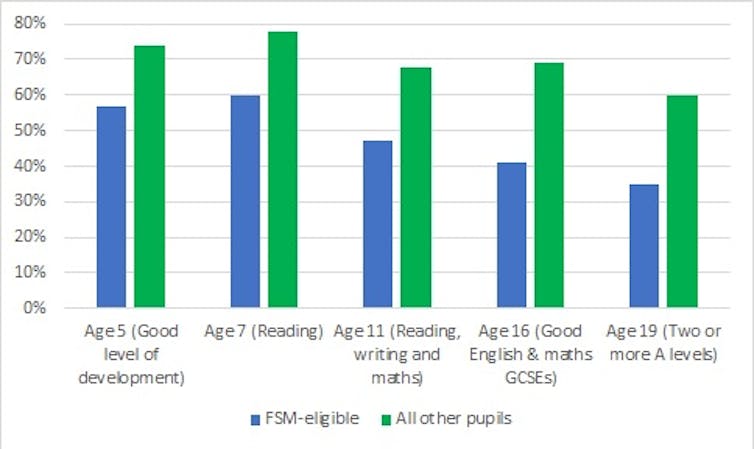
Even at the age of five, there are significant differences in achievement at school. Only 57% of children who are eligible for free school meals are assessed as having a good level of development in meeting early learning goals, compared with 74% of children from better off households. These inequalities persist through primary school, into secondary school and beyond.
Differences in educational attainment aren’t a new phenomenon. What’s striking, though, is how the size of the disadvantage gap has remained constant over a long period of time. The graph below shows the percentage of students in England reaching key GCSE benchmarks by their eligibility for free school meals from the mid-2000s.
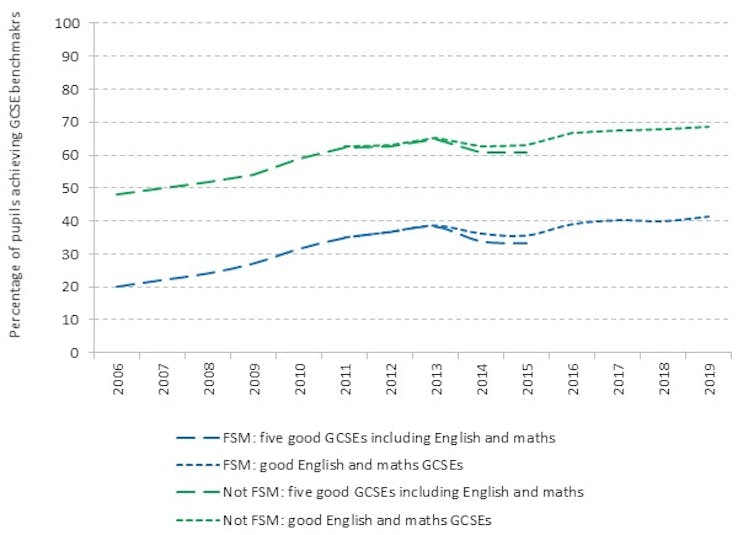
Over the past 15 years, the size of the gap in GCSE attainment between children from rich and poor households has barely changed. Although the total share of pupils achieving these GCSE benchmarks has increased over time, children from better-off families have been 27%-28% more likely to meet these benchmarks throughout the period.
Household income
While eligibility for free school meals is one way of analysing socio-economic inequalities, it doesn’t capture the full distribution of household income. Another way is to group young people according to their family income. The graph below shows young people grouped by decile. This means that young people are ordered based on their family’s income at age 14 and placed into ten equal groups.
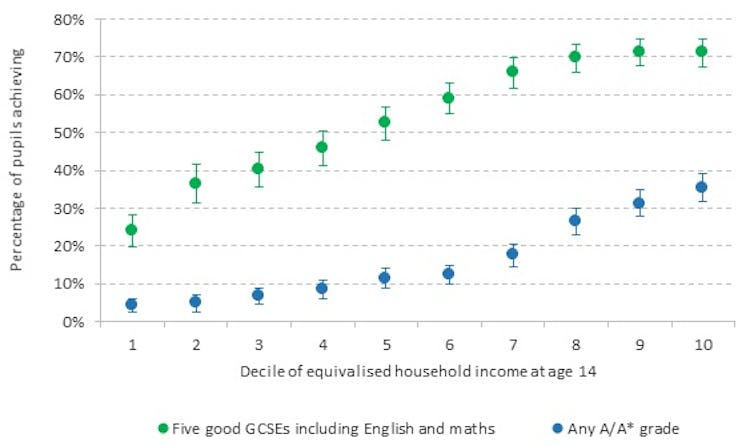
The graph shows the percentage of young people in the UK obtaining five good GCSEs, and the share obtaining at least one A or A* grade at GCSE, by the decile of their family income. With every increase in their family’s wealth, children are more likely to do better at school.
More than 70% of children from the richest tenth of families earn five good GCSEs, compared with fewer than 30% in the poorest households. While just over 10% of young people in middle-earning families (and fewer than 5% of those in the poorest families) earned at least one A or A* grade at GCSE, over a third of pupils from the richest tenth of families received at least one top grade.
Inequalities into adulthood
The gaps between poor and rich children during the school years translate into huge differences in their qualifications as adults. This graph shows educational attainment ten years after GCSEs (at the age of 26) for a group of students who took their GCSE exams in 2006.
The four bars show the distribution of qualifications at age 26 separately for the entire group, people who grew up in the poorest fifth of households, those who grew up in the richest fifth of households, and those who attended private schools.
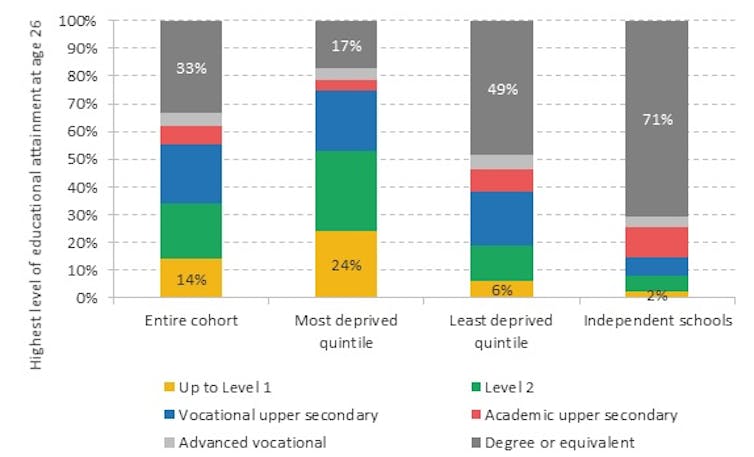
There is a strong relationship between family background and eventual educational attainment. More than half of children who grew up in the most deprived households hold qualifications of up to GCSE level or below. On the other hand, almost half of those from the richest households have graduated from university.
The gap between private school students and the most disadvantaged is even more stark. Over 70% of private school students are university graduates by the age of 26, compared with less than 20% of children from the poorest fifth of households.
Young people from better-off families do better at all levels of the education system. They start out ahead and they end up being more qualified as adults. Instead of being an engine for social mobility, the UK’s education system allows inequalities at home to turn into differences in school achievement. This means that all too often, today’s education inequalities become tomorrow’s income inequalities.
Imran Tahir, Research Economist, Institute for Fiscal Studies
This article is republished from The Conversation under a Creative Commons license. Read the original article.



