Huanyuan Zhang-Zheng, University of Oxford and Sulemana Bawa, University of Oxford
The playful and pudgy mammal that went viral from its Thai zoo enclosure has a sad story to tell about her fellows hippos. Moo Deng is the two-month-old pygmy hippo who flicks her ears in joy and likes splashing in water. She lives the life of a superstar at Khao Kheow Open Zoo, where huge crowds have massed – but the chances of spotting her relatives in the wild are slim.
Pygmy hippos
Pygmy hippos (Choeropsis liberiensis) are endangered and estimated to number fewer than 2,500. Their decline has been drastic: a long-term survey in a national park in Ivory Coast found 12,000 pygmy hippos in 1982; 5,000 in 1997 and 2,000 in 2011. Today, these hippos are scarce across their native west Africa.
Perhaps it’s not surprising that pygmy hippos feel most comfortable deep in the forest. Early European explorers to Liberia wrote in their diaries that this hippo chooses to forage at night and conceal itself in the water or in dense vegetation during the day.
So secretive is this species that 19th-century explorers observed:
if someone walks across one of their paths or tunnels (used to navigate through thick vegetation), they will abandon that route for a while.
Sensitive souls
Widespread deforestation and constant disturbance have made it difficult for pygmy hippos to survive, requiring as they do a combination of dense forests and swamps which already restricted them to a small area. West African forests have lost over 80% of their original area, which confines wild pygmy hippos to small spots in Gola National Forest (Sierra Leone) and Sapo National Park (Liberia).
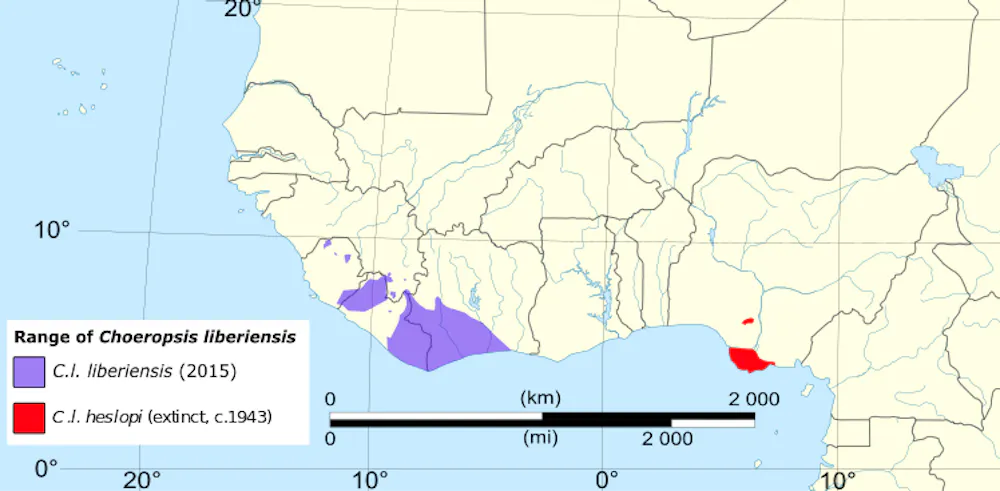
With their forests rapidly disappearing, there simply isn’t enough space for pygmy hippos to find food, thrive and reproduce. A survey in the Gola rainforest and its surroundings revealed that many were hiding on former cropland outside the protected area.
Cocoa production is probably the biggest cause of forest loss, then gold mining and unsustainable logging. These activities now encroach on forest reserves and other supposedly protected areas.
Previous forest conservation efforts have failed. Conservationists argue for a system to financially reward farmers and authorise local forestry communities to safeguard the forests and sustainably manage what remains, as opposed to a top-down model of state management and enforcement.
A world treasure
West Africa’s forest loss is particularly heartbreaking as research shows that a remaining patch may be the most productive on Earth, surpassing even the Amazon rainforest.
Particularly productive forests harness more of the sun’s energy and turn it into lots of palatable herbs and juicy fruits – more food to support animals like pygmy hippos, and so foster rich biodiversity.
Before extensive fieldwork beginning in 2016, researchers had underestimated the value of west African forests, particularly their capacity to store carbon and thereby offset global warming. This oversight was partly the result of these forests being hidden by clouds, which makes satellite observation difficult, and their relative neglect by western researchers compared with other ecosystems elsewhere.
It’s not just Moo Deng’s wider family that is at risk. West African forests are home to more than 900 bird species and nearly 400 mammals – more than a quarter of all mammal species in Africa. Their future is highly threatened by extensive deforestation.
Underestimating the value of west African forests has kept them off the priority list for global forest restoration. It’s sadly not surprising that deforestation continues. In 2022 alone Ghana lost 44,500 acres of forest (twice the size of Manchester), close to a 70% increase from 2021.
Each tropical forest contributes irreplaceable biodiversity. From the elusive mammals of west Africa to the vibrant birds of south-east Asia, these ecosystems are equally important. Comprehensive plans are needed to restore them which involve empowering local communities to manage their long-term health.
A global initiative to designate 30% of Earth’s land and ocean as protected by 2030 (known as 30×30) should not conserve a vast area in one or two places, ignoring Earth’s other biodiversity hotspots. The lesson of Moo Deng’s disappearing home should be to value ecosystems equally – and plan their preservation with equal care.
Huanyuan Zhang-Zheng, College Lecturer at Worcester College, and Postdoctoral Researcher at School of Geography and the Environment, University of Oxford and Sulemana Bawa, PhD Candidate in Conservation Biology, University of Oxford
This article is republished from The Conversation under a Creative Commons license. Read the original article.

CLICK HERE TO DONATE TO OUR CROWDFUNDER
HELP US BECOME STRONGER SO THAT WE CAN CONTINUE TO DELIVER POWERFUL CITIZEN JOURNALISM!