

Villagers in Rothbury, Embleton and Warkworth and now getting used to seeing groups of local people using their scythes to manage roadside verges and public parks. The past year has seen a great increase in the popularity of the traditional Northumbrian scythe as the best way to manage areas for the benefit of wildflowers. The scythe is a tool which dominated harvesting and haymaking for many hundreds of years but what looks easy in the hands of an expert is not quite so simple for the would-be beginner! Like so many other old traditional skills we are having to relearn what so many knew so well in times past.
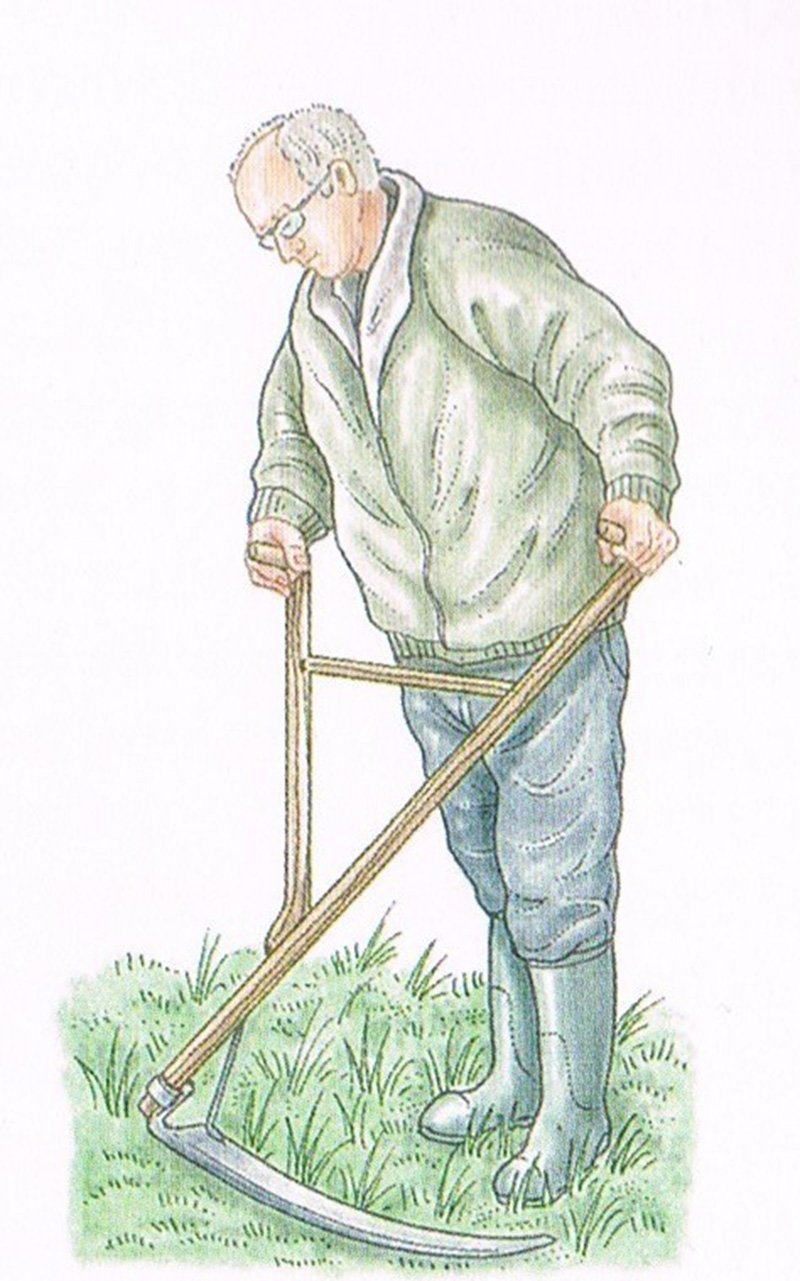
As a teenager, growing up in Embleton during the 1950s and 60s, I learned to scythe for the simple practical reason that I needed to find golf balls to fuel my passion for this game. Jock Arnott, our local gamekeeper and greenkeeper showed me how – but it took many hours of patient trial and error before I mastered the skill (particularly keeping my scythe sharp). There were no flymos or strimmers in those days so there was nothing very special about scything. In fact there were hundreds of scythes in use and for sale – I bought mine in Rothbury in 1963 and I am still using it today.
How did we get here?
So how did we get to this point in human history? For more than 200 years the human race has augmented its physical presence on Earth by using large quantities of stored sunlight (fossil fuels). This process has then been combined with:
- The “trick” of elastic supplies of money (tokens of power),
- The relentless ability of corporations to constantly grow larger
- The power which accumulations of “money” give to the “merchants of greed”
- The tendency of “populist” democracy to fan the flames of consumerism
- An economics that ignores the fact that all resources on a finite planet must be recycled
At a macro level the resulting human behaviours create a massive and life-threatening impact on Earth’s life support systems; at a micro level the dominance of wage slavery and debt becomes an effective “prison for the soul”.
For millions of centuries the magic of photosynthesis has been sucking carbon out of the air and burying it in our seas and soils. There are three key agencies which humans enjoy to take advantage of the energy of the stored sunlight which this process has created:
- The motor car
- The flush toilet
- The strimmer or lawnmower
Power over nature?
Our present civilisation evidently gets to feel highly powerful, over and above “nature”, as it enjoys these “flagship” toys which its “clever” technologies have invented. Your average punter gets some kind of spiritual kick every time he/she enjoys the sensations of mastery which these toys engender. The motor car zooms us effortlessly from place to place, the flush toilet zooms our “waste” away so it can be processed (somehow) somewhere else and our strimmers howl out their power over plants so all the world can hear it.
Small steps
Now all the rhetoric, nature documentaries, protests and political green parties may strut their stuff. This is all very fine but at some deeper level more and more ordinary people are taking their own small steps to live more harmoniously with the forces of nature. The bicycle slowly eats into car use, the composting toilet becomes less terrifying and the scythe begins to compete with the strimmer.
While the strimmer shouts out “power over nature” so all the world can hear and the grass and weeds are pulverised to a shapeless mass, the scythe sweetly transforms human energy and skill directly into a beautiful movement that calmly slices away unwanted greenery. The misguided use of technology and fossil fuel is replaced by the healthy use of human muscle and brain. And, in this process, the whole relationship between humans and the Earth is put into a new context. Scything gives the user a new, much safer and healthier, role in the management of Earth’s life processes – especially when the cut material can be properly composted so the nutrients are returned to the soil where they belong.
Scything is a practical means of giving humans access to a different kind of satisfaction which is quite different from the “power over nature” thrill so often embodied in consumerism. Better still the realisation of this satisfaction does not need to be trumpeted from the pulpits of “sustainability” – those who take up scything will find their cultural values changed without fuss or fanfare. And we can only speculate as to how far these first seeds of cultural change may grow into other areas of people’s lives. This is the subtle importance of “scything as a stalking horse for cultural change”.
Will Sutherland is co-author of “The Complete Book of Self Sufficiency”. He runs free scything workshops during summer and makes traditional Northumbrian scythes from seasoned ash with top quality Austrian blades. You can contact Will by email at wllmsutherland@gmail.com

CLICK HERE TO DONATE TO OUR CROWDFUNDER
HELP US BECOME STRONGER SO THAT WE CAN CONTINUE TO DELIVER POWERFUL CITIZEN JOURNALISM!