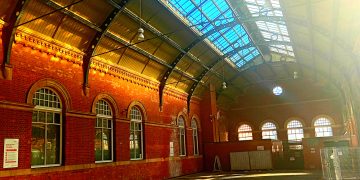
The Northumberland Line is now fully operational at a cost of slightly over 300 million pounds. The next step, which would be to extend it to the coast at Newbiggin-by-the-Sea, will cost around 200 million.
The Northumberland Line
Half a billion for the whole line is a lot of money, and given that this is the precise amount that went into the Restoring your Railways fund that Chancellor Rachel Reeves cancelled during her first year in office on grounds of budget constraints, you could say that Northumberland Council and organisations like SENRUG (South-East Northumberland Rail Users Group) have fought a great campaign over two decades, rising above setbacks on the way. And it’s not over yet, with the whole area in need of a comprehensive regional railway system, (see SENRUG’s many well-thought-through proposals) not least because the county not only requires business investment but is becoming increasingly popular with tourists and needs the infrastructure to cope with new demand.
Half a billion to restore a railway line which had remained in use for freight may sound like a lot, but much had to be done in terms of building new stations, bridges and neighbouring facilities like car parks, not to mention making the railway fit for passenger trains. Problems faced included an unexploded wartime bomb and subsidence caused by mine workings. Yet in its first year of operation, the line was used over a million times, a figure that ran way over all expectations and formal predictions. And it undoubtedly generates new business. Take this report on a sixteen-million pound leisure development at Ashington as part of the Portland Park project to revitalise the area. It is specifically linked to the opening of the Northumberland Line which will make it easier to access the town. And there are educational advantages too. Northumberland College’s new Ashington Campus is bound to be more attractive to students and staff when they know they’re next to a half-hourly train service into Newcastle.
Even so, there are lots of hoops to jump through on the way to success. As Rail Magazine reported, when the North-East Combined Authority recently released money for extending the line to Newbiggin, it was described as being ‘first funding’ in order to support a ‘feasibility’ study. After that comes a ‘Strategic Outline Business Case,’ which will cost more money and involve a lot of bureaucracy. It may prove unreliable, if the estimates for usage are anything like the original estimates for the use of the rest of the Northumberland Line. All this will take time and enable the government to turn the project down as ‘economically unjustified’ or put it on hold before it ever begins. Even optimists agree that work on the line won’t start before 2028.
HS2
Meanwhile the estimated cost of another new railway project, HS2, is over 100 billion, 300 times the cost of the Northumberland Line. Why is it so expensive?
One reason is that a high-speed line has to go straight. But the route from London to Birmingham is densely populated, with a lot of towns and villages along the way. If you’re not going to demolish everything that stands in your path like a tank, you must head downhill. This is from a BBC report in July 2025:
“One of the most expensive parts of these measures were the tunnels. Through public consultation and the hybrid bill, the design now features so many of them – along with noise barriers and cuttings, where track is laid below ground level – that on a 49-minute journey from London to Birmingham passengers will only have a view of the countryside for nine.”
Apart from the huge cost of all those tunnels and cuttings, one wonders whether people will prefer spending an hour looking at tunnel walls to an hour and a quarter looking at trees and meadows. Moles might fancy it, but I’d rather take the ‘slow train’ and enjoy nicer views, besides which I bet it will be a lot cheaper.
Then there is the matter of compensation. The BBC report continues:
“Councils, businesses and individuals made their case in front of a government committee asking for everything from noise barriers to financial compensation for communities losing green space…. Sir Geoffrey Clifton Brown was a Conservative MP and was one of the committee members who heard out petitions. ‘I remember very clearly one of the Secretaries of State for Transport, after an afternoon session, say, well done, Geoffrey, you’ve just cost us another couple of hundred million this afternoon.’”
200 million pounds for a single compensation pay-out! The whole cost of extending the Northumberland Line to Newbiggin-by-the-Sea, assuming you get past the ‘feasibility study’ and the ‘Strategic Outline Business Case’! All spent in an afternoon by Sir Geoffrey, doubtless to receive a pat on the back from his chums as they made their way to their London club.
It’s very unlikely that the current Labour government will follow Simon Jenkins’ advice in The Guardian and put the whole HS2 white elephant out of its misery, even though that alone would save seven billions a year, enough to pump a lot of support into health and education services, not to mention restoring a few railway lines. The transport secretary Heidi Alexander claims that it would cost as much to cancel the project as to continue to the end (something Simon Jenkins disputes in his article – once again it comes down to an argument about compensation). It will therefore continue to swallow up billions each year throughout the next decade. If only a feasibility study and Strategic Online Business Case had been properly done twenty years ago!
The conclusion is that costs vary up and down the country for new railway lines. Sometimes they are worth it and sometimes not. But one thing is clear. Money should never be wasted on vanity projects rather than renewal, and continue to be wasted by a government that can’t bring itself to cancel the folly it inherited.

CLICK HERE TO DONATE TO OUR CROWDFUNDER
HELP US BECOME STRONGER SO THAT WE CAN CONTINUE TO DELIVER POWERFUL CITIZEN JOURNALISM!