

The nightmare in Myanmar
Myanmar or Burma as it is also called was a British colony following the three Anglo-Burmese wars in the 19th century, until 4 January 1948. It had been little more than an appendage to the British Raj in India to the British, but it was also home to tens of millions of people, who wanted to live in peace.
Already one of the key figures in what would be a free Burma was out of the picture, with the assassination of General Aung San in July 1947. Aung San had originally supported the Japanese invasion of Burma in the Second World War but came over to the British side later.
Aung San favoured a federal Burma, which would respect the large cultural differences between the various ethnic groups within Burma, including not only the Burmans but also many other groups such as the Karens, the Karenni, the Kachin, the Shan, the Wa and of course the Rohingya.
Following the assassination of Aung San, Burma as it was still called became a very centralised state, a formula that was rejected by many of the ethnic minorities. Although there was some level of democracy, it was very fragile and in March 1962 the Burmese army took control of the country under the leadership of General Ne Win.
An increasingly brutal reign of terror enveloped Burma through the 1960s until the 2010s and many ethnic groups suffered from attacks and persecution.
In 1982, the Rohingya minority on the western edge of what had now been renamed Myanmar, lost their right to citizenship with the enactment of the 1982 Citizenship Law. This loss of basic rights was to have disastrous consequences for the Rohingya people a quarter of a century later.
In 2015, Aung San’s daughter Aung San Sui Kyi became state counsellor of Myanmar, in what seemed a democratic step forward, but the army still regained much of the power in the land.
Then in August 2017, a number of incidents in Rakhine State involving the police gave the Burmese army the excuse to attack the Rohingya people and the result was the terrible Rohingya genocide of 2017.
Disappointingly, Aung San Sui Kyi , who had been seen as a human rights icon, did little or nothing to stop it. Among other consequences, she was stripped of her Freedom of Newcastle that she had been awarded in 2011.
The subsequent genocide saw thousands of Rohingyas being brutally murdered and as many as 700 000 being forced to flee to neighbouring Bangladesh for a difficult life in refugee camps.
The background to the memorial
Led by Independent Newcastle Councillor Cllr Habib Rahman, this memorial honours the resilience, suffering, and ongoing journey to justice by the Rohingya people.
The memorial has been developed through a collaboration between Newcastle City Council, Rohingya Action North East (RANE), the British Rohingya Community (BRC), and the Burmese Rohingya Organisation UK (BROUK).
Independent Cllr Habib Rahman who is standing down in May commented:
“This memorial will stand as a reminder that we must never be silent in the face of genocide. It honours the Rohingya struggle and reinforces our shared responsibility to ensure dignity and justice for all.”
A moral imperative and a global message
The group behind the memorial have stated that “this permanent memorial is more than a site of remembrance. It is a symbol of truth, a call for justice, and a powerful rejection of silence. The Rohingya people have endured one of the most severe humanitarian crises of the 21st century, marked by widespread violence, displacement, and loss of life”.
About the memorial
The memorial stone has been funded jointly by BRC, RANE and BROUK. It was crafted by Nationwide Headstone Company Ltd, has been funded jointly by BRCs.
“This memorial is a step toward justice, reconciliation, and a future where ‘never again’ becomes reality,” added Cllr Rahman.
Memorials as living testaments
It is also noted by the organisers that permanent memorials such as this one play a vital role honouring those who were killed, while also educating future generations.
They also challenge denial and historical revisionism, while acknowledging survivors ‘ experiences
The memorial ceremony
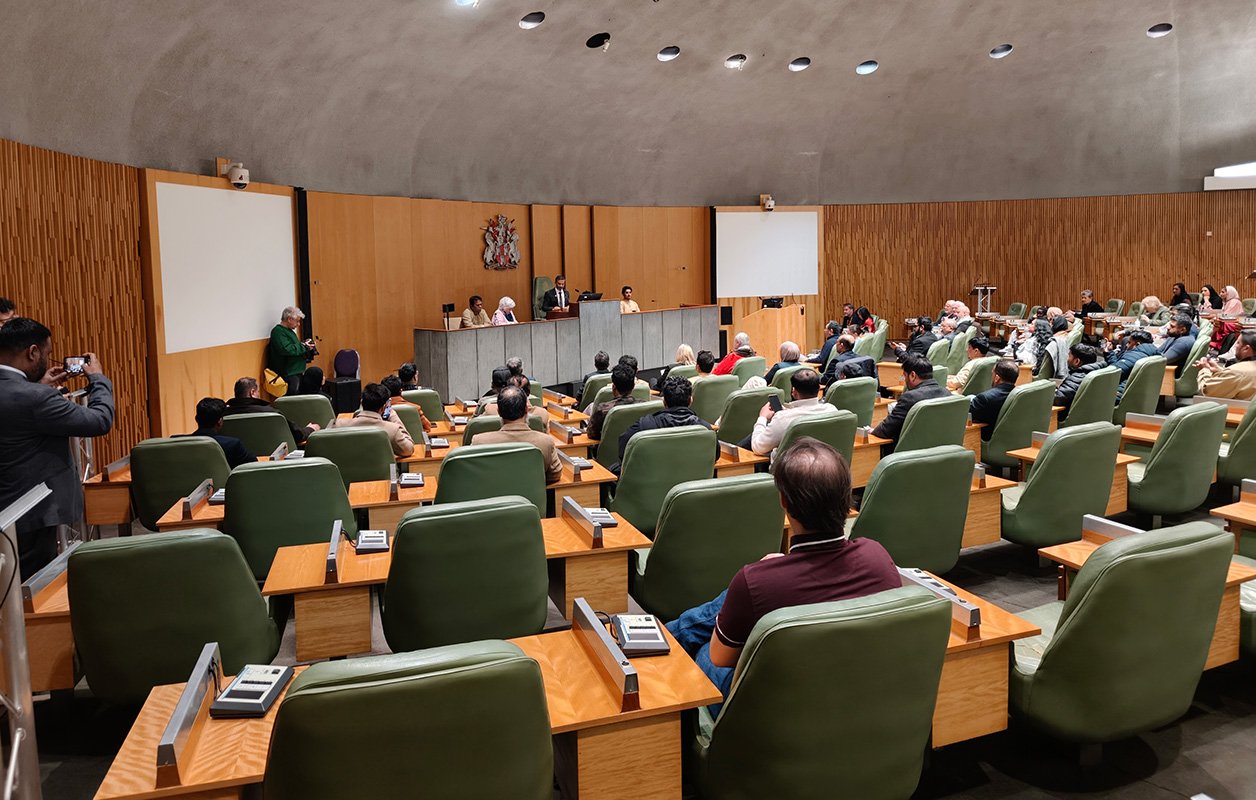
Sunday 12 April dawned bright and breezy and by 11.40 a large crowd had gathered at the council chamber at Newcastle Civic Centre. Speakers spoke of why it was such an important event and why the persecution of the Rohingya people needs to be remembered.
It was also mentioned that the event honoured the suffering of the Rohingyas for decades both before and since the genocide nine years ago.
Then we went outside where the Lord Mayor unveiled the memorial to the memory of the Rohingya people who were brutally murdered and raped during the genocide in 2017.
The people of Burma deserve better
This memorial ensures that the Rohingya people’s suffering is remembered and recognised. Meanwhile, as has been documented on NE Bylines, the recent sham elections in Myanmar ensure that the suffering of the people of Burma as a whole, including Kachins, Karens and of course Rohingyas among many other groups continues.
Hopefully this memorial will add to pressure on our government to work more effectively with others to help the long-suffering people of Burma gain their long-awaited freedom
To learn more about how you can help the Rohingyas and other people in Burma, please see here .