
A striking graphic, tweeted by Professor John Tomaney and taken from a Joseph Rowntree Foundation report encapsulates North East England’s mental health crisis. The data from 2020 shows that of the ten areas of England with the highest antidepressant use, seven are located in the North East.
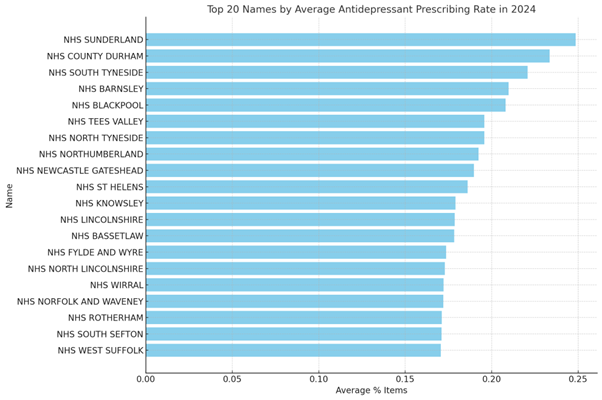
Using data from openprescribing.net, I managed to create an updated table for 2024 which shows an unchanged picture. Every single NHS area in the North East region ranked amongst the top ten for per-capita antidepressant prescribing.
(You can review the raw data here)
To be honest, this doesn’t just make me feel sad. It also makes me feel angry. Is it a coincidence that a region which struggles so much across a range of quality of life indicators also happens to be the one with the highest prevalence of antidepressant prescriptions?
For Lively Minds, the mental health podcast, I sat down with Alisdair Cameron, Co-Director of independent mental health charity: ReCoCo to dig further into these questions.
Alisdair tells me that rates of depression and anxiety and use of A&E for mental health reasons are higher in our region than the national average. North East England has also had the highest suicide rate in England for three out of the past four years.
And yet, Alisdair continues, this is “despite the fact that for many years, we have had services which have been rated by CQC, etc. as being very good services. So clearly there’s something going on, which points to there being a disconnect between … mental health services … and the levels of need that are out there.”
The North East is wonderful – yet forgotten about
North East England is somewhere I am so proud to call home. At the risk of sounding a bit soppy, if our people, our natural beauty and our spirit is anything to go by, then our quality of life should be entirely conducive to positive mental wellbeing. We have long been a hub of innovation. Our cultural legacy is equally impressive—spanning ancient relics to the vibrant arts scene of today. And from the rolling Durham Dales, to the rugged Cheviot Hills, to the pristine Northumberland coastline, our natural beauty leaves visitors in awe.
And yet we are also a region that struggles, all too often finding ourselves at the wrong end of the league table on a whole range of socio-economic measures. I reel off some of these to Alisdair: the highest child poverty rate in the UK, higher than average unemployment, lowest life expectancy, worse than average health outcomes, lowest disposable household income in England. The list could go on. “Sometimes it feels like the North East is geographically the furthest English region from power” I add.
“If there’s poor quality of life in a region, you will have poor mental health outcomes” replies Alisdair. “I mean, I wouldn’t want to say the North East is the most peripheral of the regions. I guess Cumbria would probably want a word and maybe Cornwall too. … But these are very similar situations where your lack of proximity to power means that your voices are not heard, your concerns are not heard, and you are essentially forgotten about.”
“I think overwhelmingly our region is one that has seen mass de-industrialization, seen no real meaningful long-term replacement for the old heavy industries that sustained the region. And so that economic decline, which leads to lower incomes, leads to lower standards of living, obviously that has an effect upon people’s sense of worth, people’s sense of purpose.”
Solutions?
So what are the bespoke solutions that our region needs in order to reverse its deteriorating mental wellbeing?
“We’re seen as one block” says Alisdair. ”It’s a lot of people, and it’s an awful lot of territory as well, a lot of ground. So it’s dispersed population, many different centres, which means that it’s hard for services to reach everybody, when they are as dispersed as they are, it’s also hard for services to function just across sheer distance.”
This highlights the need to redesign and implement mental health services at a much more local level to cater for the unique challenges faced in different parts of the region. I find it interesting that – somewhat paradoxically – one of the bespoke solutions required for the North East is recognising the variety of need within the region itself. Bespoke and localised solutions make sense when you consider how densely populated centres such as Newcastle and Sunderland compare with what are some of the most rural and sparsely populated areas of England.
It also becomes clear during our conversation that whilst a reliance on the third sector to plug gaps in provision could be seen as a symptom of the chronic under-investment in England’s mental health services, there’s no denying that it plays a vital role in reaching solutions to our region’s mental health quandary. ReCoCo, the charity that Alisdair is co-director of, is part of those efforts.
The organisation is led by people with experience of using mental health services, and its mission is to help build people’s resilience by exchanging knowledge and building networks of mutual support.
“I think we offer a sense of camaraderie and a sense of hope for people” he says. “We’re not a replacement [for statutory mental health services]. In an ideal world we’d be complementary. And sometimes when the system does work, that’s how it is. We give people lots of stuff to do for all the times when they can’t see a clinician. But we’re not a replacement for other bits of the system.”
We wonder whether ongoing devolution to the English regions might one day lead to us being able to make more of our own decisions on matters that impact our region’s mental health. In 2016, Greater Manchester became the first combined authority to be handed control over its £6bn health and social care budget. What potential could similar autonomy over health spending in the North East have for our mental health outcomes? Perhaps getting a little carried away, I fantasize about the North East having the same kind of tax-raising powers that enabled California in the US and Queensland in Australia to raise more funding for cash-strapped mental health initiatives. Alisdair talks of how transformational a less punitive benefits system could be, describing the current state of affairs as “one of the biggest drivers of people’s poor mental health.”
As things stand, we are a long way off having the autonomy required to implement any of the more fiscally or politically fundamental changes which could have the most profound impact on improving our region’s wellbeing. Before the Scotland Act devolved limited social security powers to Holyrood in 2016, the Scottish government did manage to implement a ‘workaround’ for the infamous bedroom tax by providing grants to offset its effects.
Meanwhile at the North East’s first Child Poverty Summit in November, our current regional mayor, Kim McGuinness announced £55 million of funding to tackle the “staggering” levels of child poverty in the region. It will be interesting to see the extent to which this initiative, alongside the already established regional Child Poverty Unit, improves the life chances and wellbeing of future generations.
Alisdair is understandably sceptical about the extent to which political initiatives will meaningfully improve mental health outcomes for our region, especially as we keep being told by central government that there’s no money.
He concludes: “the greatest asset that we have is our people. And we’ve got people who are their kind, their canny, their compassionate, their skilled, they’ve got resilience. We are our own best solution to the problems we face and that’s where the hope lies.”
Lively Minds is a volunteer-run podcast, led by users of mental health services.
You can listen to the entire conversation between Alisdair Cameron and I by searching ‘Lively Minds’ in your favourite podcast app, or by clicking this link to listen via the website.

CLICK HERE TO DONATE TO OUR CROWDFUNDER
HELP US BECOME STRONGER SO THAT WE CAN CONTINUE TO DELIVER POWERFUL CITIZEN JOURNALISM!