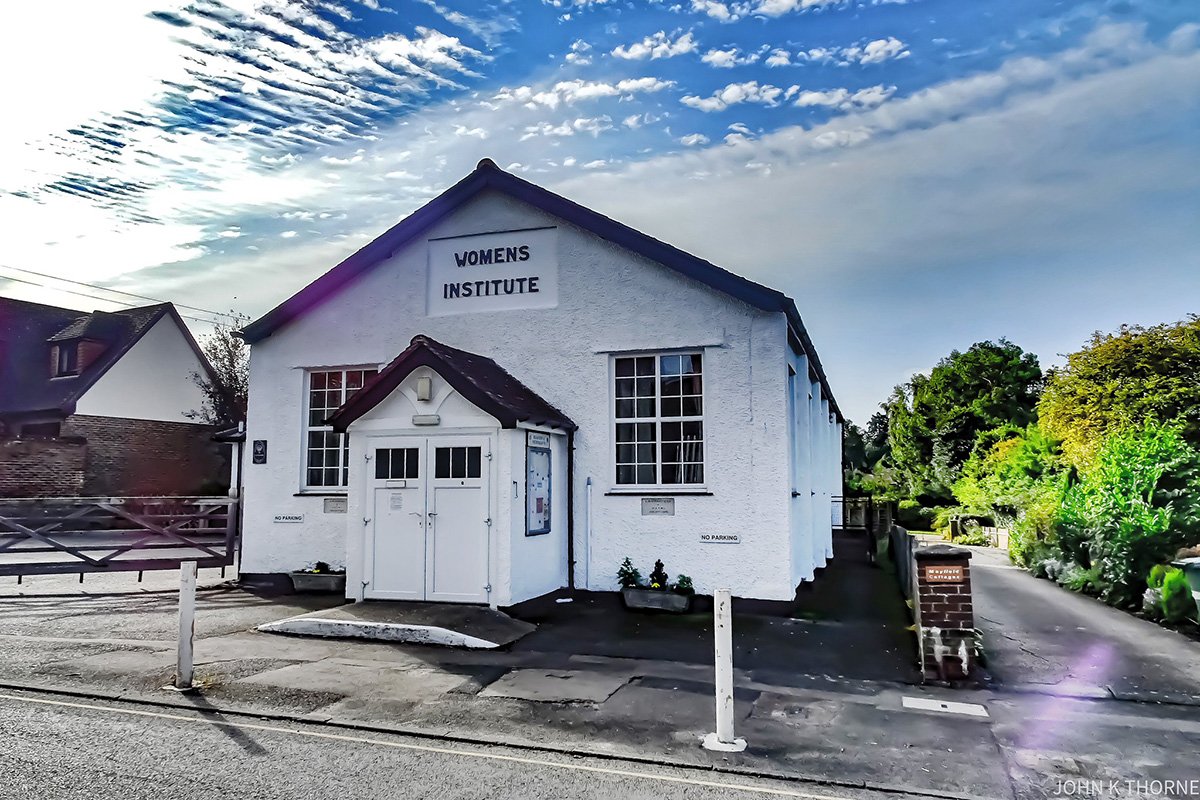
I’m sitting in a draughty village hall somewhere in Northumberland, the smell of disinfectant rising faintly from the polished floorboards, waiting to give a light-hearted talk to the Women’s Institute. The chairs are stacked in haphazard towers against the walls; there’s a trestle table in the corner with a checked cloth draped over it and, next to that, a tray of tea things. A plate of homemade scones teeters, half-wrapped in clingfilm. It’s all very WI. Or at least its what people think the WI is – jam, Jerusalem, a whiff of lavender and talcum powder, ladies in twinsets bustling about with purpose. Except, of course, that’s not the half of it.
The WI
The WI, I’ve discovered, is a vibrant, occasionally riotous collective of women who – alongside baking, crafting and raising thousands for charity – like nothing better than to let their hair down and have a good laugh. I know this because I’ve been on their speaking circuit for years now, schlepping about the countryside of the North East to entertain them with anecdotes from my rather patchwork career: part-doctor, part-dentist, part-comedy writer. A jack of all trades, really, and master of none – except perhaps the art of getting lost on the way to obscure village halls.
It wasn’t always like this. When I started doing these talks, I was overly polite, tiptoeing around anything that might seem risqué. I thought: don’t mention anything too personal, avoid anything controversial, and certainly no jokes about sex. I was, in short, the human equivalent of a cucumber sandwich – perfectly inoffensive and just as flavourless. But then one day, at a WI in some hamlet whose name I’ve since forgotten, the chairwoman took me to one side. “We like to have a good laugh,” she said, “a proper belly laugh. So don’t hold back.” She said it like a challenge, and who was I to refuse?
The next time I spoke, I was bolder. I threw in a few cheeky stories, and they howled. It was the kind of laughter that builds until it shakes the room, as if they’d all been saving it up. Afterwards, they thanked me as if I’d performed a public service, and in a way, I suppose I had. In small villages, the WI is often the social lifeblood of the community. The chance to come together, be entertained and have a good giggle – that’s precious.
A regular on the circuit
So now I’m a regular on the circuit. In the early days, I had to hustle for gigs, even auditioning at an event where prospective speakers were paraded before a panel of unsmiling women, their arms crossed as they judged us. It felt a bit like The X Factor, only with fewer sequins and no Simon Cowell. These days, I get booked through word of mouth, which is just as well because I’m no good at self-promotion. My talks are an amalgam of anecdotes about my medical and dental career, spliced with my earlier life as a comedy writer. The tone? Think “open surgery” meets Radio 4.
What I’ve learned is that performing for the WI is not so different from doing stand-up comedy, which I dabbled in before all this. Timing is everything. A good opening is crucial – if they’re not laughing within the first minute, you’re in trouble. Thankfully, I’ve got a reliable opening line that usually lands well, although the first time I tried it I felt like a man proposing in public, unsure if he’d get a “yes” or a polite cough.
There’s an old saying in comedy: “If the audience can see your feet, they’ll trust you.” It’s true. That’s why I refuse to stand behind a lectern. Nothing kills rapport like hiding behind a solid wooden structure, visible only from the nose up, like a head on a stick. It reminds me of one particularly grim corporate gig where I was chained to such a lectern, the audience scattered across a cavernous conference hall, chatting amongst themselves. The microphone crackled, the lights buzzed, and I could feel the laughter evaporating into the gloom. Never again.
With the WI, it’s different. You feel the connection immediately – a warmth, an eagerness. These aren’t women looking to be dazzled by someone more important than them. They want to feel like they know you, and if you can make them laugh as if you’re all sharing a secret, so much the better.
Of course, it’s not all plain sailing. There are tricky audiences, usually when I misjudge the room – too many stories about dentistry, not enough about writing for comedians on TV, or vice versa. But I’m better at reading the crowd now. I pace myself, punctuating my talk with slides and props, and I’ve learned to enjoy the silences as much as the laughs. It’s a conversation, not a sprint.
These days, the hardest part isn’t the performing, it’s the travel. I’ve spent too many evenings squinting at blurry road signs, praying I’m not about to end up in a farmyard by mistake. But once I’m there, parked outside the village hall with its peeling paint and sagging noticeboard, I feel a strange kind of contentment. It’s the same satisfaction I used to get from pulling off a tricky tooth extraction or delivering a well-timed punchline on a sitcom. It’s the sense of having done something small but worthwhile.
When it’s over, I pack up my props, say my goodbyes and drive home, replaying the evening in my mind. I sleep better now than I used to after gigs, though roadworks and motorway diversions have a habit of trying my patience. What I love, though, is knowing I’ve made people laugh. In a world that feels increasingly fraught, there’s something deeply comforting about that – about finding joy in the familiar rhythms of a WI meeting, a cup of tea, a rendition of Jerusalem. It’s not just entertainment, it’s connection. And for that, I’m grateful.
First published in Leicestershire and Rutland Yearbook