



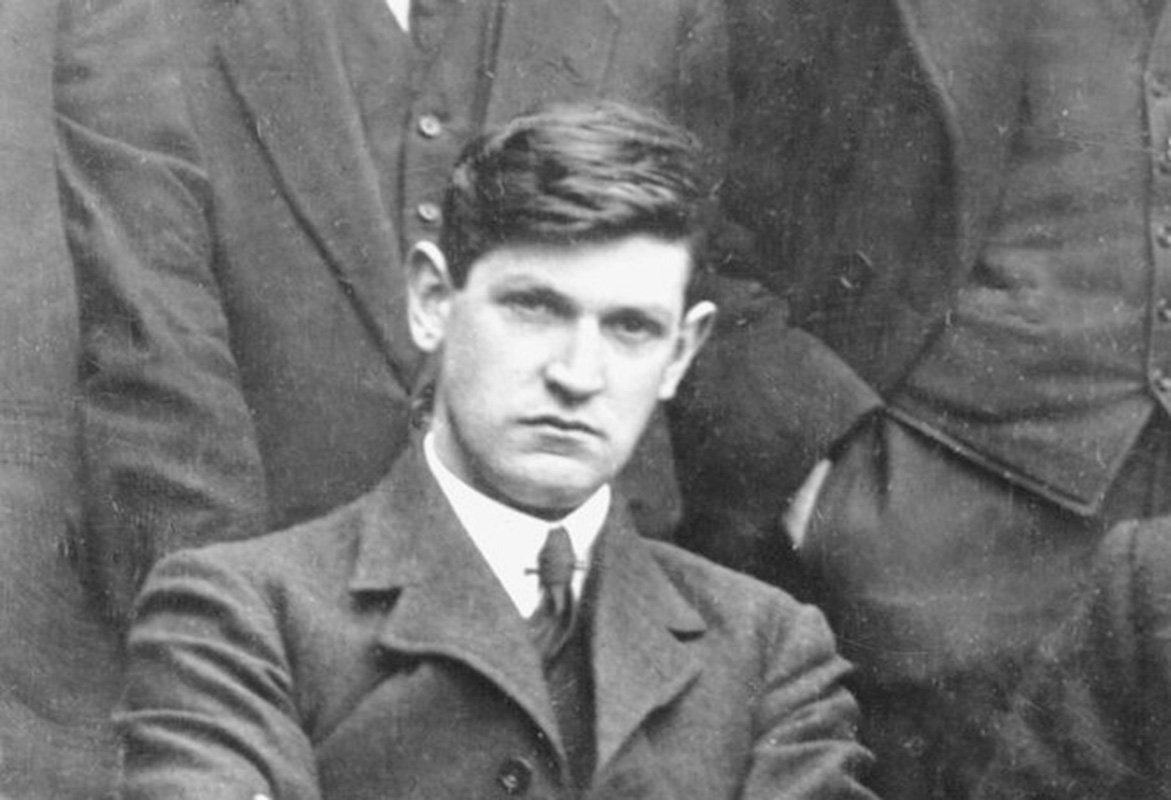
“By the by I wonder if you were raided at all?”
As Patricia Taylor waded through the papers of her mother, newly deceased at a venerable age, she happened upon a letter from Middlesbrough neighbour Mrs Ann O’Neill, now also passed away.
A local poet, O’Neill had set out the findings of her research into Michael Collins, “The Big Fella”, the leader who fought and died for an independent Ireland. She had tried to verify a local rumour – that the Irish leader had paid a secret visit to his sister, a nun at a Teesside convent.
O’Neill’s research was inconclusive, but she did mention three letters still in existence from Michael to his sister Lena, a nun at a Sisters of Mercy convent in Normanby. Lena had taken the name of Sister Mary Celestine.
The letters
We tracked down the letters which are lodged at the National Library of Ireland.
Collins’ three letters to Lena were written between 1918 and 1921, when an independent Ireland was being forged in the white heat of revolution and war.
In his first letter, of 21 February 1918, Collins mentioned that this was the first letter he’d ever written to her (she’d left home 17 years before). It sets the theme of apologies for late replies. Occasionally there’s the glimpse of the cheeky baby brother:
“..even to people who are not nuns I am a very bad correspondent- consequently I am very unwilling to submit my production to the holy critics.”
In each letter Collins mentions sending Lena back-copies of the Catholic Bulletin, at the suggestion of their sister Mary – seemingly to ease the extra demands of Lent in an already austere life of work, prayer and charity.
Amid the personal news there are some insights into the events that were moulding the future independent Ireland even as he wrote.
In this first letter he asks if she would be allowed to have the photo he’d had done in his “regimentals as Irish Volunteer Commandant.”
Leadership
By the time of his first letter, Collins, born in October 1890, had joined the leadership of nationalist politics. Working for the Post Office, he moved to London in 1906. There he joined the Gaelic League, Irish Republican Brotherhood (IRB) and the Irish Volunteers. He returned to Ireland in 1916, after a year in the United States.
His rapid rise to republican leadership came thanks to the British government.
The authorities’ response to the Dublin Easter Rising of 1916 was to execute the leaders by firing squad – igniting the fury of the Irish public and creating a power vacuum. Collins, who had spent a few months in jail for his role in the Rising, took on a raft of leadership positions on his release in December 1916. He was key in rebuilding the IRB.
Meanwhile the British government’s cloth-eared attempt at conscription to feed the Great War meat grinder ended in defeat and Irish outrage.
At the December 1918 General Election, 73 Sinn Féin MPs were elected in a landslide win. Collins became the Sinn Féin MP for South Cork.
The Sinn Féin MPs refused to attend the Westminster parliament, declaring an Irish Republic and their own assembly – Dáil Éireann – the first meeting (in January 1919) of which marked the beginning of the Irish War of Independence. At that time Collins became Director of Intelligence of the southern Irish Republican Army (IRA).
The second letter, of 13 April 1919, was written three months into the War of Independence.
Collins writes:
“The week which has passed has been a busy one for us perhaps it has been an historical one, for very often we are actors in events that have very much more meaning and consequence than we realise. At any rate – permanent or not, consequence full or not – last week did I feel, mark the inception of something new. The elected representatives of the people have definitely turned their backs on the Old order and the developments are sure to be interesting. Generally the situation is working out to the satisfaction of Ireland – that is in foreign countries. At home we go from success to success in our own guerilla way. Escapes of prisoners, raids against the enemy etc.”
Perhaps Collins was referring to the second, meeting of the Dáil Éireann on 1 April which declared a breakaway government, in which Collins became minister for finance.
With an escalation of guerilla tactics, Collins was seeing the growing success of his strategies.
The final letter we have is dated 5 March 1921 as the War of Independence still rages.
He has an unusual question for a nun secluded in her convent:
“By the by I wonder if you were raided at all – the enemy took a whole lot of my old private letters – poor mother’s mortuary card not being left even – and surely there must have been some one of yours among them. They raided all the known addresses.”
Fame
He’s become a lot more famous – or infamous as the British press sees him. He replies to his sister,
“Yes indeed the English papers have been giving me plenty of notoriety – a notoriety one would gladly be rid of but they must make a scapegoat. Daily Sketch had a gorgeous thing once upon a time – “Mike”, the super hater, dour, hard, no ray of humour, no trace of human feeling – oh lovely! The white horse story was an exaggeration. I have not ridden a white horse since I rode “Gipsy” and used her mane as a bridle.”
Also a horror at the loss of life in the ongoing civil war:
“We are losing many splendid men – many fine noble friends. I hope some one will be left to pay due tribute to their deeds and their memories – but only one tribute can repay them – the freedom of this land and in God’s good time that will rest with us”
A truce was called on 11 July 1921. The war had claimed over 2,300 lives – including 515 Irish fighters and 900 civilians.
For Collins perhaps it was the direct threat of renewed war that persuaded him as negotiator to sign the Anglo-Irish Treaty with the British in December 1921.
He was hardly enthusiastic about the agreement, in the face of opposition from his brothers in arms including Éamon de Valera.
The treaty was not a recognition of a sovereign Irish state, but of a Dominion that still owed allegiance to the Crown, much like Canada. It also allowed for the partition of the island leaving the north in British hands. To Collins, the agreement was a stepping stone to full independence (which it later, under de Valera, turned out to be). To its detractors it was a betrayal.
Collins said “I think I have signed my actual death warrant” – and how right he was.
Collins became commander-in-chief of the National Army and Chairman of the Provisional Government after signing the treaty,
The Irish Civil War between supporters and opposers of the treaty broke out immediately after the agreement was signed. On 22 August 1922, Collins was killed in an ambush at Beal na Bláth Co. Cork, not by the hated English but by his own Irish countrymen.
Michael died 21 years to the day after Lena left home on 22 August 1901.
Late in life, Lena described her departure for the Sisters of Mercy convent in Hull. Michael, the youngest of eight, was six years Lena’s junior and around 10 at the time
“I left home on Aug 22nd 1901 and only Mother came with us. Michael would like to come but Mamma thought it would upset me too much – so he just watched till the pony trap was out of sight.”
That was the last she would see of him, as far as we know.
Lena would go on to teach with her order in the South Bank area of Teesside.
In 1919 the local nuns moved into Crossbeck House in Normanby.(It’s now a children’s hospice.)
She remained at Crossbeck Convent, becoming head teacher of St Peter’s elementary school in nearby South Bank (where she taught Pat Taylor’s mam).
She later retired to the Sisters of Mercy Convent at Whitby where she died in 1972 aged 88.
The question remains: did Michael visit her in secret at her convent in Normanby? During the time Lena was living there, Michael had a £10,000 price on his head. Although he was no doubt free of the bounty later in 1921 when he was in London for negotiations during the truce.
But we have no evidence of a visit, only secondhand rumours.
Perhaps the story should remain a mystery that cannot be proved or disproved. What we do know for sure is that his sister the nun was on her knees every day in her convent, praying for his safety, and after his death for his soul. As he wrote in his last letter,
“It is good and pleasant and hopeful to know that one is thought of and prayed for though one may deserve neither. I suppose Providence has its own ways of fixing things.”



