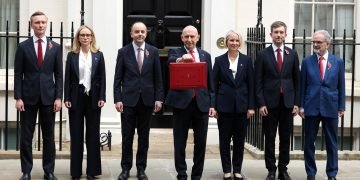
In the House of Commons, a curious architectural detail remains as a reminder of a more violent age. Two red lines on the floor, running the length of the chamber, spaced exactly two sword-lengths apart. This was a practical measure so that “honourable members” could not reach one another with a blade during a debate. Today, while the steel has long since been replaced by rhetoric, the symbolic distance between these lines feels increasingly inadequate. The conflict has now moved beyond the green benches and into the digital and social fabric.
For decades, the United Kingdom’s political system has been defined by its adversarial nature. From the physical layout of Parliament to Prime Minister’s Questions, the model is built on the premise that the best policies emerge through vigorous challenge. However, observers across the political spectrum, as well as academic institutions and polling organisations, have noted a shift. The discourse has moved from a contest of ideas to what is widely described as a “toxic” environment. Understanding this phenomenon requires looking beyond individual personalities to a convergence of technological, socio-economic, and psychological factors.
The Brexit realignment: identity over policy
You cannot analyse the current state of British discourse without examining the 2016 European Union referendum. Regardless of the arguments for or against Brexit, the vote introduced a fundamental shift in the British political psyche. It moved the primary axis of political disagreement from traditional economic interests toward “identity politics.”
For many, “Leaver” and “Remainer” became primary social identities that transcended traditional party loyalty. Political scientists refer to this as “affective polarisation”. This is where people don’t just disagree with the opposing side but view them with a sense of distrust. As the referendum was a binary choice, it created a winner takes all dynamic.
This period of prolonged uncertainty necessitated a high level of “base mobilisation” from all sides. This turned the debate into an existential struggle for the country’s future. The result was a political landscape where compromise was frequently framed as a betrayal. This sentiment has persisted in debates over other social issues long after the UK’s formal exit from the EU.
The fallacy of the “political package”
Perhaps the most damaging development is the growing tendency to assume a person’s entire worldview based on a single opinion. In a healthy democracy, individuals are seen as complex beings capable of holding a mosaic of beliefs. However, the current climate often demands “ideological purity,” and citizens are expected to subscribe to a prepackaged set of “left” or “right” opinions.
This is fundamentally flawed. It is entirely possible and historically common for an individual to support high levels of state spending on the NHS (traditionally a “left” position) while simultaneously favouring strict border controls or traditional social values (traditionally “right” positions). Conversely, a voter might champion free market deregulation while being a staunch advocate for radical progressive social reforms.
When we assume that someone is “right leaning” or “left leaning” based on a single disagreement, we commit a logical fallacy that stifles independent thought. It creates a “totalising” politics where you must buy the whole set of beliefs or be cast out as an enemy. This tribalism discourages people from engaging with specific issues on their merits. Instead, they feel pressured to adopt the “correct” stance of their perceived tribe to avoid social ostracisation. This binary labelling narrows the public square, forcing a diverse population of 67 million people into two narrow, warring camps that do not actually reflect the complexity of human conviction.
The digital colosseum and the outrage economy
The transformation of political discourse is also inextricably linked to the architecture of digital platforms. Platforms such as X (formerly Twitter), Facebook, and TikTok operate on algorithms designed to maximise user engagement. Data suggests that “high arousal” emotions, specifically anger, moral outrage, and fear, are the most effective drivers of engagement.
This “outrage economy” has fundamentally altered how political messages are delivered. In the digital sphere, nuanced arguments are often reduced to ten second clips designed to provoke a reaction. This rewards inflammatory language and creates a feedback loop where representatives and commentators are incentivised to use hyperbolic rhetoric to remain visible.
Furthermore, the online disinhibition effect removes the social constraints that typically govern human interaction. When participants are separated by screens, the “other” is often reduced to an avatar, making it easier to employ language that would be considered socially unacceptable in a face to face setting. This has led to a chilling effect, where moderate voices often withdraw from public conversation to avoid abuse, leaving the digital square to be dominated by the most polarised elements of society.
Media fragmentation and the loss of a shared narrative
The media landscape has also undergone a profound transformation. For much of the 20th century, a handful of national broadcasters and newspapers acted as gatekeepers. While these outlets had their own editorial leanings, they generally operated within a shared set of facts.
The current landscape is much more fragmented. The rise of opinion led broadcasting and niche digital news sites has provided a wider range of perspectives, which many see as a positive for democratic pluralism. However, it also allows for the creation of echo chambers. When different segments of the population consume news from entirely different sources, they often end up with different sets of ‘facts.’ This makes constructive dialogue nearly impossible, as the parties involved are no longer disagreeing on the solution to a problem but on the very nature of reality itself.
Economic stressors and the politics of scarcity
Finally, the material conditions cannot be ignored. Political civility is historically easier to maintain during periods of economic expansion. However, the UK has faced a decade and a half of economic headwinds, including the aftermath of the 2008 financial crisis, a period of fiscal consolidation, the Covid – 19 pandemic, and a historic cost of living crisis.
When people feel their standard of living is stagnating or declining, social friction inevitably increases. In an environment of perceived scarcity, political arguments often turn toward finding someone to blame. This grievance based politics is inherently more confrontational than the politics of aspiration. Whether the target is the elite, big business, unions, or migrants, the rhetoric of blame deepens divisions between different segments of the population.
Conclusion: reclaiming the middle ground
The toxicity of political discourse in the UK is the result of a complex interplay of factors: an adversarial political structure, the identity shaping impact of the Brexit years, the mechanical incentives of social media, and a period of prolonged economic stress.
However, the most vital step in cooling our public debate is a return to individuality. We must reject the urge to categorise our neighbours as “enemies” based on a single point of contention. Democracy is not meant to be a process of finding a tribe and staying there; it is meant to be a continuous, good faith negotiation between people who will inevitably disagree on some things while agreeing on others.
Those two red lines in the House of Commons serve as a reminder that political disagreement has always carried the potential for conflict. But they also remind us that we have survived through a commitment to rules, decorum, and the understanding that the person across the aisle is an “honourable member,” not an existential threat. Restoring a more constructive discourse will require us to look past the labels and rediscover the person behind the opinion.

Friends of Bylines Network
There has never been a greater need for grassroots journalism that investigates the stories that really matter, holds power to account and champions the voices of everyday citizens. We are proudly powered by volunteers but what we do isn’t free.
STAND WITH US for independent, citizen-led journalism that makes democracy stronger, and you will even get some exclusive benefits.