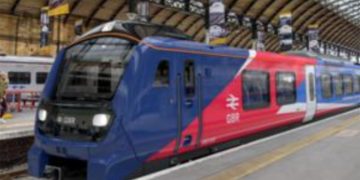
15 December marks one year since the Northumberland Line between Newcastle upon Tyne and Ashington was re-opened to passenger traffic for the first time in six decades. It has been hailed as a great success, far exceeding expectations about likely take-up.
Annual usage was estimated to be 380,000 and is instead currently (December 2025) close to 800,000. The popularity of the line has been reflected in requests to secure more carriages (at least at certain times of day) and to run trains more often (particularly later in the evening). This is now happening. Fares have also been kept low. Three quid is the maximum fare for getting from Newcastle to Ashington. Six quid is the cost of a return – about the same as a pint of beer.
Weighing the cost
The main downside has been the cost, which has doubled from an original bid of about £168 million to £336 million. An obvious point often made is that even a third of a billion is a drop in the ocean compared to the cost of projects like HS2. But more important is the argument that a line costing a third of a billion can pay for itself in the medium term if you consider the financial benefits.
This part of Northumberland has suffered from the closure of collieries at the end of the twentieth century. Its coal-mining past is now remembered largely through the Woodhorn Museum (which the line may be extended to pass by) and, ironically, through some of the difficulties concerning subsidence which engineers found in building new stations along the line. The railway, which was once built to reflect the fact that Ashington was ‘the world’s largest coal-mining village’, will now help to attract students to Northumberland College, visitors to an increasingly popular part of the country and new businesses. The local council declared in December 2025 that the line had led to a surge in developers ringing the Council’s planning department. There will also be savings in terms of making roads less congested.
Towards an integrated transport system
The Northumberland Line has been integrated with the Tyne and Wear Metro, both in terms of getting from one to the other and using the same tickets. Yet anything approaching regional management remains difficult. A local bus company has refused to use a bus bay built to pick up passengers at Newsham because it will ‘add time to existing journeys.’ This is daft. You build a station, place a car park and a bus bay with room for turning next to the platform and then the bus company tells you it messes up their timetable, so they won’t use it. Even within train services themselves, different companies have different priorities. At present, LNER is proving more difficult to interest in local train services than Northern. Their priority seems to be to get people from London to Edinburgh as quickly as possible. Even telling them that restored local lines could help relieve bottlenecks on the main line seems to have limited appeal.
A collective approach
The campaign to restore the Northumberland line took at least two decades and would not have been possible without consistent backing from local politicians and organisations. It meant a willingness to consult and persuade, including running well-refreshed politicians and business leaders in a special train chartered by SENRUG, a voluntary organisation promoting rail services in Northumberland and beyond, along the line (which was still used for freight) back in 2008. It meant interesting local schools and communities in the project. It meant dealing with endless legal and technical regulations to make sure that the line with its new stations and signalling system was considered safe. It meant being patient when yet another delay was found to be inevitable (the last two stations on the line will be opened in 2026). But one thing makes it worthwhile. Everyone who has faced these delays knows that it might have taken over two decades to get the line re-opened, but once open it will last for decades, perhaps centuries. There are not many new developments of which that can confidently be said. The Northumberland Line will be remembered when the Millennium Dome has been forgotten.
A collective approach means private-public partnerships. Since 2017 local authorities have been given more power to work with the private sector to develop new rail projects. It also means joint working across the political divide. Most of the local MPs are Labour, as is the Mayor for the North East, Kim McGuinness, but the Leader of Northumberland Council, Glen Sanderson, is Conservative. This has not prevented them from working together in support of the project.
Grow to spend, or spend to grow?
The approach of the present government has been focused on economic growth as the precondition of spending, but that principle can be turned on its head. Sometimes you must spend to grow. You can’t just wait for the growth to come and then spend. In July 2024 the new Chancellor, Rachel Reeves, axed the Restoring your Railways fund. It didn’t affect the Northumberland Line, but it was feared that the projected reopening of the Leamside Lane would be hit by the ‘Reeves axe.’ In the end, at least some of the line is likely to restored. Enough ministers in the government seemed to recognise that spending on infrastructure was a way of boosting economic growth, and were willing to support it even when there was an apparent ‘black hole’ in national finances.
If parts of the North East are to recover the economic vitality that once came from heavy industry like coalmining and shipbuilding, it is foolish to wait until new industries appear as if dropped from the sky. New businesses will come and growth will follow in depressed areas if there is infrastructure to encourage their development. The very fact that use of the line has been twice what was expected suggests that many a ‘business case’ developed to weigh the pros and cons of restoring railway lines may be prone to under-estimating the benefits. Spending what are relatively small sums on strengthening regional connectivity makes economic sense, especially when compared to the £33 billions spent on providing a faster commute between Birmingham and London. For that sum, you could have re-opened 100 Northumberland lines. Perhaps that would have been a better thing to do.